Latest Insights .

September 30, 2026

Why Most Giveaways Fail to Generate Long-Term Customers

A giveaway wraps up. The entry count looks great, and the team calls it a win. Then three months pass, and none of it shows up anywhere that matters. No bump in repeat purchases. No real growth in the customer list. Just a folder of names nobody opens again.

This happens a lot. Giveaways are easy to run and easy to measure right after launch. Entries are visible, they’re easy to count, and they look great on a recap slide. But entries are not customers. Treating them like the same thing is the root of the problem. The mistakes that cause it aren’t new, either. The same few show up in giveaway after giveaway, and most of them have a straightforward fix once a brand knows to look.

The Prize Attracted the Wrong Crowd

The most common mistake starts before the contest even launches: the prize itself.

A gift card, cash, or a popular gadget with no real link to the brand pulls in a huge crowd. It also pulls in people who have zero interest in what the brand actually sells. These are the accounts that follow every giveaway on their feed, enter dozens a week, and unfollow the moment the winner is picked. Lots of entries, very little interest, and almost no chance any of them become a paying customer.

A prize tied to the product does the opposite. Fewer entries, sure, but the people who show up already care about the category. They’re not there for a free gadget. They’re there because they actually want what the brand makes.

Picking a Prize on Purpose, Not by Habit

This is a tradeoff brands need to make on purpose instead of stumbling into. A big generic prize will always win on raw entry numbers. A relevant prize wins on the number that actually matters six months down the line: how many entrants turn into customers.

Entry Mechanics Never Asked for Anything Useful

Plenty of giveaways ask for the bare minimum. An email address, maybe a follow, maybe a tag. That’s fast for the entrant, but it leaves the brand with almost nothing to work with once the contest is over.

Now compare that to an entry form with a short preference question, a product pick, or a quick quiz. Same effort from the entrant, but now the brand actually learns something. Which product they like. What problem they’re trying to solve. What kind of message might land with them later.

Without that extra layer, every entrant looks identical on paper. A brand has nothing to personalize a follow-up with, so everyone ends up getting the same generic email. Generic emails get generic results.

The One Question Most Forms Skip

A lot of teams drop this question from the form on the assumption that any extra step costs entries. That assumption rarely holds up. One short question barely moves the total number, and the payoff down the line outweighs whatever small dip it might cause on launch day. A brand that asks nothing upfront ends up guessing at everything downstream. A brand that asks one good question skips the guessing entirely.

This has to be fixed at the entry form, not after the fact. Once the contest closes, there’s no way to go back and ask people questions they were never asked to begin with.

The Follow-Up That Never Got Built

This mistake shows up more than any other, and it’s rarely about effort. It’s about where that effort went.

Almost all the planning time on a giveaway goes toward the launch. The creative, the prize, the entry flow, getting the page live. The period after the winner is announced usually gets one “thanks for entering” email and nothing else. Not because anyone decided that on purpose, but because the team is tired, the budget’s gone, and announcing the winner gets treated as the finish line.

But the interest a contest builds doesn’t disappear the day the winner is picked. People who entered are still paying attention right after that announcement. That’s exactly the moment a brand needs a real follow-up plan, and it’s exactly the moment most brands leave empty.

A giveaway with no post-contest plan isn’t really a customer acquisition campaign. It’s a short spike in attention with nothing built to hold onto it.

Everyone Got Treated the Same Way

A flat list of entrants isn’t really an asset yet. It only becomes one once it’s split apart by how each person engaged.

The winner deserves a different message than someone who only submitted an email and did nothing else. Someone who answered a product quiz deserves different follow-up than someone who spent ten seconds on the page. And any existing customers who happened to enter shouldn’t get pushed into a generic “welcome to the brand” series they don’t need.

Skipping this step means every entrant gets the exact same email no matter how engaged they were. That makes a genuinely interested entrant feel like just another name on a list, and it wastes whatever signal the entry form managed to collect.

The Follow-Up Was One Email, Not a Real Sequence

Even brands that do send something after the contest often send just one message, usually the same day the winner is announced. That single email tries to do everything at once. Thank people, promote a product, ask for a follow, and push a sale, all in one shot.

What a Real Sequence Looks Like

A real sequence starts somewhere, builds, and ends somewhere else. The opening message tells people who won, thanks everyone for showing up, and leaves them with a reason to stick around. A second message goes out a few days later with something for everyone who didn’t win, usually a small offer that rewards them without asking for a full purchase. Only after that does the sequence move into an actual product message, ideally tied to whatever the entrant showed interest in during the contest.

Cramming all of that into one email doesn’t just weaken the message. It burns through the best window a brand has to keep the conversation going, since entrants are only paying close attention for a short stretch right around the announcement.

Retargeting Stopped at the Entry List

A lot of brands treat the entrant list as the whole audience worth retargeting, which leaves a big chunk of interested traffic completely untouched.

Anyone who landed on the entry page and left without finishing is a warmer prospect than cold traffic, even if they never actually entered. So is anyone who clicked in from an ad but bounced off the landing page. None of that traffic shows up in the entrant list, but all of it saw the brand and showed some interest.

The other common mistake is running the same ad creative for weeks after the contest ends. Entrants have already sat through a lot of the brand’s messaging in a short window, so that creative goes stale fast. Once the contest wraps, the ad message should pivot toward an actual product or offer instead of repeating a pitch people have already seen.

Lookalike Audiences Get Skipped Too

There’s a second retargeting mistake that’s easy to miss because it doesn’t involve the entrant list at all. A well-run contest produces a useful seed audience for lookalike targeting on paid social, and a lot of brands never build one. The entrants who converted into customers, not just anyone who entered, make the strongest seed group. Skipping this step means the brand only ever markets back to people it already reached, instead of using the contest to find new prospects who look like the ones who actually stuck around.

User-Generated Content Went Straight Into a Folder

If the contest asked people to submit photos, videos, or captions, that content is usually the most wasted asset from the whole campaign.

Real customer photos make better social proof than studio shots most people don’t fully trust anymore. UGC often performs better than polished brand creative in paid social. A recap post brings back people who didn’t enter this time but might next time. None of that happens if the submissions just sit in a folder after the winner is picked.

The other piece brands miss is permissions. Reposting UGC on social and running it in paid ads usually need different levels of rights, and that has to be checked against the official contest rules before any of it goes back out. Skip that check, and content that could have been an asset turns into a legal headache instead.

The Data Never Made It Into the CRM

Even a contest with good segmentation and a solid follow-up plan can still fail long-term if the data dies with the campaign. Contest data sitting in its own spreadsheet, cut off from the brand’s real CRM and lifecycle marketing, is only useful for as long as that one email sequence runs.

Tagging contacts by entry source lets a brand compare contest-driven leads against other channels later on. What matters is how many entrants become paying customers, not how many opened an email. Get quiz answers and preferences into the brand’s personalization work, and a contest stops being a one-off and starts paying off long after it ends.

Nobody Defined What Success Meant Before Launch

The last mistake is the quietest one, and it’s why so many giveaways get called a win when they really weren’t. If a brand only decides what success looks like after the campaign wraps, entry count becomes the default measure, since it’s the easiest number sitting right there.

Setting a thirty- and sixty-day checkpoint before the contest even launches changes that. A target open rate for the follow-up emails. A conversion goal for the retargeted audience. Several UGC pieces cleared for reuse. Picking those numbers ahead of time is what forces a team to actually check back in two months later, instead of letting the whole campaign’s success rest on how big the entry count looked on day one.

Measuring the Right Numbers

Part of why entry count sticks around as the default metric is that it’s the only number that exists the moment the contest closes. Email engagement by segment, retargeting conversion, repeat purchases among entrants, and cleared UGC all take weeks to show up, and by then attention has usually moved to the next campaign.

That’s a reporting problem more than a results problem. A brand that builds a short checklist ahead of time, reviewed at thirty days and again at sixty, gets to see the real outcome instead of guessing at it.

Did entrants from the relevant-prize group convert at a better rate than the ones chasing a generic prize? Did the segmented sequence outperform a single blast email? Those answers only exist if someone bothers to check, and checking only happens when it’s built into the plan from the start rather than left for whoever remembers later.

Fixing the Pattern

None of these mistakes are really about the entry phase. That part usually works fine. Brands are good at getting people to enter something when there’s a decent prize attached.

Where things fall apart is everything the entry phase was supposed to set up. A prize that attracts the right people. An entry form that collects something useful. A segmented list. A real follow-up sequence with an actual arc. Retargeting that reaches past the entrant list. A plan for the content people submitted. And a way to feed all of it into the CRM so it doesn’t disappear the moment the campaign ends.

A giveaway that skips all of this can still hit its entry goal and still fail at the one thing that actually matters: turning a stranger’s five seconds of attention into someone who sticks around. The entry count was never the finish line. It was just the point where the real work was supposed to start.

11 Best Branded Contest Ideas That Drive ROI

11 Best Branded Contest Ideas That Drive ROI

A giveaway with a gift card and a simple entry form might get attention for a week. It rarely builds the kind of engagement a brand team can defend in a quarterly review. The best branded contest ideas do more than hand out prizes – they create measurable actions, generate qualified leads, and give audiences a reason to participate with your brand instead of scrolling past it.

For marketing teams under pressure to show performance, contest strategy matters as much as creative. A branded promotion has to fit the audience, the offer, the channel mix, and the business goal. If the objective is lead generation, the contest should capture meaningful first-party data. If the goal is awareness, shareability and reach need to be designed into the experience. If loyalty is the priority, the promotion should reward repeat interaction rather than one-time clicks.

What separates the best branded contest ideas from basic giveaways

The strongest campaigns are built around one simple principle: the entry mechanic should support the marketing outcome. That sounds obvious, but many promotions fail because the format and the goal do not match.

A sweepstakes can drive high-volume entries quickly, but it may not produce the depth of engagement that a user-generated content campaign delivers. A photo contest can build advocacy and social proof, but it takes more effort from participants and more moderation from the brand. An instant win game creates repeat visits and urgency, but the prize structure and odds need to be thought through carefully.

That is why there is no single best format in every case. There are, however, contest models that consistently outperform when they are matched to the right business objective and executed with the right technology, legal framework, and post-launch support.

1. UGC photo contests for social proof and brand affinity

Among the best branded contest ideas for consumer-facing brands, photo contests remain one of the most effective. They ask customers to show how they use, wear, experience, or interpret your brand. That gives you more than entries. It gives you authentic content, visible brand participation, and a stronger emotional connection than a standard registration form can produce.

This format works especially well for hospitality, education, CPG, retail, and lifestyle brands. The trade-off is that entry friction is higher. People need a reason to create and submit. Prize value helps, but so does a theme that feels easy, fun, and relevant.

If you want the campaign to scale, voting can extend the life of the promotion by bringing friends and followers into the experience. That second layer of participation often turns a submission-based campaign into a broader awareness engine.

2. Video contests when the story matters

Some campaigns need more than a snapshot. Video contests are a strong fit when the brand story is central to the promotion, or when the audience needs room to explain, demonstrate, or perform.

Admissions teams can use this format for scholarship or campus experience campaigns. Consumer brands can use it for testimonials, product hacks, or fan stories. Agencies often like video because it creates reusable content with higher perceived value.

The limitation is production effort. Video entries typically produce fewer submissions than photo contests, but those submissions are often more compelling. If quality matters more than quantity, this is one of the best branded contest ideas available.

3. Vote-to-win campaigns for reach and repeat traffic

Voting promotions do something many campaigns struggle to achieve: they turn participants into promoters. When entrants want votes, they share. When audiences come back to vote, the campaign gets repeat visits and extended engagement windows.

This format is particularly effective when a brand wants to amplify reach without relying solely on paid media. It can also help reveal what creative themes, products, or stories resonate most with the audience.

That said, voting campaigns need controls. Fairness, fraud protection, and transparent rules are not optional. For brands that care about data integrity and reputation, the technology behind the voting experience matters as much as the front-end design.

4. Instant win games for urgency and repeat participation

When the goal is frequency, instant win promotions are hard to beat. Spin-to-win, peel-and-reveal, and similar game formats create immediacy. Participants know right away whether they have won, which keeps the experience light, fast, and habit-forming.

These campaigns are especially useful for retail promotions, seasonal programs, loyalty initiatives, and product launches. They can drive daily traffic, encourage repeat visits, and support segmented prize strategies.

The business case is strong when you need a promotion that feels interactive without requiring heavy user effort. The trade-off is that instant win mechanics need careful prize planning and a clear fulfillment process. If either is weak, the customer experience can slip quickly.

5. Quiz-based contests for lead qualification

Not every brand needs maximum entry volume. Sometimes the real objective is learning more about the audience while keeping participation high. That is where quiz-based contests stand out.

A quiz can help segment users by preferences, buying intent, product fit, or knowledge level. For admissions marketing, it might guide prospective students toward the right program. For consumer brands, it might match participants with products or experiences. For publishers, it can turn passive readers into registered leads.

This is one of the best branded contest ideas for teams that need more than an email address. A well-built quiz captures data that sales and lifecycle marketing teams can actually use.

6. Refer-a-friend sweepstakes for audience acquisition

Referral mechanics work because they put advocacy inside the entry process. Instead of hoping participants share, the campaign rewards them for it.

This approach can be highly effective for list growth, app adoption, subscriptions, and member acquisition. It is also appealing when the audience already has a strong community component, such as colleges, fan bases, associations, or niche consumer categories.

The key is not to overcomplicate the incentive structure. If participants have to decode the offer, referral rates drop. Simple reward logic and a trustworthy user flow usually outperform ambitious but confusing mechanics.

7. Receipt upload contests for purchase validation

If the goal is sales lift rather than pure awareness, receipt upload campaigns are a practical choice. They tie entry to a verified action, usually a purchase, which makes them valuable for CPG brands, retail partners, and promotional teams that need to connect engagement with transaction behavior.

This format can support rebates, sweepstakes, bonus entry programs, and loyalty extensions. It also gives brands a more defensible way to measure promotional impact.

The challenge is operational. Receipt review, validation, and customer support need to be handled well or friction rises quickly. Still, when revenue accountability matters, this is one of the strongest options available.

8. Hashtag contests for lightweight participation

Hashtag contests are often attractive because they feel simple and social-native. They can work well for awareness campaigns, event tie-ins, and community participation pushes where the barrier to entry needs to stay low.

But this format is not always as easy as it appears. Social platform rules, moderation concerns, and content ownership questions can complicate execution. A hashtag campaign may generate visibility, but it may not generate the same level of lead capture or data richness as a hosted contest experience.

That does not make it weak. It just means it is best used when visibility is the primary objective, not when the campaign has to do heavy lifting for CRM growth or qualification.

9. Caption contests for fast engagement

Caption contests are one of the simplest ways to invite creative participation without asking for full UGC production. A brand posts an image or short video, and users submit captions for a chance to win.

This can work well for publishers, entertainment brands, sports properties, and social-heavy consumer campaigns. It is fast to launch, easy to understand, and well suited to mobile audiences.

The upside is accessibility. The downside is that the data and content value may be lighter than what comes from deeper campaign formats. It is a strong tactical option, especially when speed matters.

10. Milestone or anniversary contests for loyalty

When a brand is celebrating a company milestone, product anniversary, venue reopening, or member achievement, the promotion can become more than a traffic play. It can reinforce customer loyalty and brand identity.

These campaigns work best when the contest ties into a larger narrative. That might be asking customers to share memories, vote on favorite moments, or enter for a commemorative prize package. The campaign becomes a participation event rather than a generic giveaway.

For established brands, this is one of the best branded contest ideas because it uses existing affinity instead of trying to manufacture it.

11. Multi-stage promotions for larger campaign goals

Some marketing objectives are too ambitious for a single mechanic. A campaign might start with a sweepstakes for broad acquisition, move into a UGC phase for deeper engagement, and then add voting or instant win elements to maintain momentum.

This layered approach is often the right fit for enterprise campaigns, major launches, seasonal pushes, and agency-led programs with multiple KPIs. It requires stronger planning, tighter execution, and better analytics, but it can produce a much more complete result.

This is where an expert partner matters. Contest Factory, for example, has built its approach around custom promotional experiences, patented voting capabilities, and proprietary analytics that give marketing teams direct visibility into registrations, submissions, votes, shares, and overall campaign performance.

How to choose the right branded contest format

The best decision usually starts with a hard question: what does success actually need to look like? If your team needs qualified leads, choose a format that captures meaningful data. If your team needs awareness, prioritize shareability and participation volume. If your team needs loyalty, build for repeat visits and ongoing interaction.

Then look at audience behavior. A highly motivated fan base may participate in a video contest. A broader consumer audience may respond better to instant win or sweepstakes mechanics. A B2C brand with strong visual appeal may get more value from photo submissions than from a standard entry form.

Finally, be honest about execution. Legal compliance, official rules, AMOE handling, moderation, fraud prevention, mobile optimization, and prize fulfillment are not side details. They shape campaign risk and campaign performance. The best idea on paper can underperform if the operational side is treated as an afterthought.

A strong branded contest does not just attract entries. It earns attention, captures useful data, and gives your audience a reason to stay engaged after the prize is awarded. That is the standard worth aiming for.

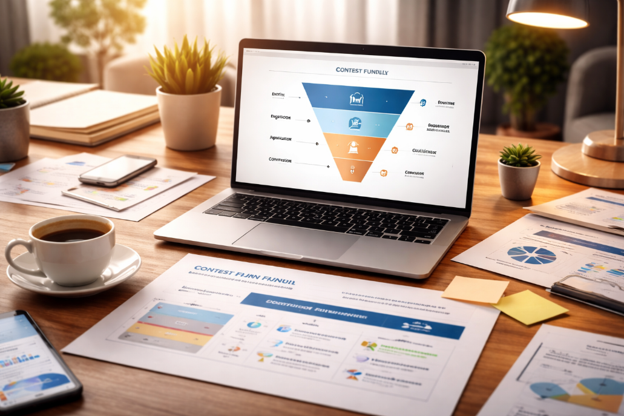
Building a multi-phase contest funnel

Designing a Multi-Phase Contest Funnel That Converts in 14 Days

Most contests collect attention, yet very few generate revenue with multi-phase contest funnel. In fact, many campaigns achieve 20–40% opt-in rates, but fewer than 5% of participants convert into buyers. The issue is not traffic volume; instead, it is structural design.

Brands focus on maximizing entries, and as a result, they fail to engineer buying decisions. However, a contest can become profitable when it operates inside a controlled 14-day decision cycle.

14 days creates enough time to qualify intent, reinforce product exposure, and introduce urgency, while still maintaining attention. This framework builds a structured conversion pipeline.

Revenue Architecture: Define the Purchase Outcome Before Launch


A contest without a defined purchase target becomes a lead list. Therefore, before building mechanics, prizes, or bonus actions, you must define the exact revenue action the campaign is designed to produce. Otherwise, engagement metrics will look strong, yet sales impact will remain weak.

Identify the Primary Conversion Action

First, clarify what “conversion” actually means inside this funnel. It must be singular and measurable.

  • Direct sale for lower-ticket products
  • Pre-order for limited launches
  • Booking or consultation request for high-ticket services
  • Subscription activation for recurring models

Next, calculate the average decision cycle of your product. If your product typically requires three meaningful exposures before purchase, the contest must deliberately create those exposures.

Additionally, define the minimum number of product interactions required before a participant becomes sales-ready. Without this clarity, urgency in Days 11–14 will feel forced.

Reverse-Engineer the 14-Day Timeline

Once the outcome is defined, structure the timeline backward.

  • Days 1–3: capture segmentation data and initial intent signals
  • Days 4–7: evaluate behavioral qualification through tracked actions
  • Days 8–10: reinforce product positioning and familiarity
  • Days 11–14: deploy structured conversion triggers

This sequencing ensures that urgency is earned through qualification, not rushed prematurely. As a result, the closing window feels logical rather than aggressive.

Set Performance Benchmarks

Finally, define performance targets before launch so evaluation remains objective.

  • Revenue per 1,000 participants
  • Engagement score threshold required for offer exposure
  • Target purchase rate within 14 days

When these metrics are set in advance, the contest stops being an experiment and becomes a measurable revenue system.

Phase 1 (Days 1–3): Entry Structure That Captures Intent Signals

Phrase 1 of the multi-phrase contest funnel

Entry design determines downstream conversion power. If you only ask for name and email, you collect contacts. However, if you design the entry correctly, you collect purchase indicators.

Build a Segmented Entry Form

Your entry form must quietly qualify participants while still feeling simple. To achieve that balance, include fields that map directly to buying probability.

  • Product interest selection
    Ask participants which product category interests them most. For example: “Which collection are you most interested in?” Each selection becomes a product-interest tag inside your CRM. Later, your emails can show only relevant SKUs instead of generic promotions.
  • Budget bracket
    Include 3–4 price ranges. For example: “What price range are you considering?” This answer becomes a price-sensitivity tag. High-budget participants should not receive discount-heavy messaging early.
  • Purchase timeframe
    Ask: “When do you plan to purchase?” Options such as “Within 2 weeks,” “Within 1 month,” or “Just exploring” create a time-intent tag. This tag will heavily influence who receives the Day 11–14 offer.
  • Use-case context
    Clarify why they want the product. Gift? Personal use? Upgrade? This becomes a motivation tag, which shapes your messaging tone.

Every answer must automatically attach to the participant profile as a structured CRM tag. Do not store it as plain text. You need filters, automation triggers, and segment logic. Otherwise, the data becomes useless.

Introduce Progressive Qualification

If you ask too many questions upfront, completion rates drop. Therefore, structure the entry in layers.

  • Step 1: Email and first name. Low friction. High completion.
  • Step 2: Product interest and timeframe. Behavioral qualifier.
  • Step 3 (optional): Budget or use-case. High-value signal capture.

For example, if someone selects “purchase within 2 weeks,” you can unlock a small bonus entry in exchange for answering the budget question. That incentive protects completion rate while increasing signal quality.

This structure allows you to collect meaningful intent data without overwhelming participants.

Apply an Early Scoring Model

Once data is collected, assign weighted value immediately.

Example scoring logic:

  • Purchase within 2 weeks = +10 points
  • Budget above mid-tier = +8 points
  • Product-specific interest = +6 points
  • “Just exploring” = +1 point

Then define clusters:

  • High intent: 18+ points
  • Medium intent: 8–17 points
  • Low intent: 0–7 points

By Day 3, you already know who deserves stronger messaging later. That clarity prevents wasted communication and protects your closing window.

Phase 2 (Days 4–7): Behavioral Qualification Based on Product Interaction

Phrase 2 of the multi-phrase contest funnel

Entry answers show declared interest. However, actions show real intent. Therefore, Phase 2 must focus on observable behavior tied directly to product exposure.

Track Product-Specific Actions

Inside your gamified platform, connect bonus entries to product-driven behavior.

Examples:

  • Bonus entry for visiting a specific product page
  • Bonus entry for watching 75% of a demo video
  • Bonus entry for using a configurator
  • Bonus entry for adding a product to wishlist

Each action must trigger an event tag inside your CRM. Use tracking pixels and UTM parameters to connect multi-phase contest funnel actions with website behavior. Without this connection, you cannot measure real engagement.

For example, if a participant watches the demo video and returns the next day to view pricing, that pattern signals elevated purchase readiness.

Establish a Depth-of-Interest Score

Now refine the scoring system using behavioral signals.

  • Time on product page above 90 seconds = +5 points
  • Repeat visit within 48 hours = +7 points
  • Exploring multiple product variations = +6 points
  • Single shallow visit under 10 seconds = 0 points

These weighted actions create a depth-of-interest score. As a result, you move beyond entry answers and focus on demonstrated engagement. Importantly, do not overvalue one action. Purchase probability increases when multiple signals combine.

Promote High-Intent Participants Into a Priority Segment

By Day 6 or 7, combine entry score and behavior score.

Set clear promotion rules:

  • Total score above 25 points → move to priority conversion segment
  • Two repeat product visits within 72 hours → auto-upgrade
  • Email click + product interaction within 24 hours → escalate tier

Additionally, set engagement frequency triggers. If someone interacts three times in four days, they deserve stronger messaging. Conversely, silence indicates lower readiness.

This structured promotion ensures that by the time Phase 3 begins, your messaging intensity matches real buying probability.

Phase 3 (Days 8–10): Structured Product Reinforcement

Phrase 3 of the multi-phrase contest funnel

Before a purchase offer appears, familiarity must increase. At this stage, you are not pushing a discount. Instead, you are strengthening confidence. Participants must feel informed, reassured, and mentally committed. Therefore, Days 8–10 focus on controlled reinforcement built around behavioral tiers.

Use Micro-Commitments to Increase Buying Probability

Large decisions feel risky for some of the best market trends. However, small actions reduce friction. That is why micro-commitments matter.

Encourage actions such as:

  • Download a buying guide tailored to their selected product category
  • Compare product variations inside an interactive chart
  • Save a personalized configuration for later access

For example, if someone configures a product size or selects features, that action signals psychological ownership. Consequently, the probability of purchase increases. Additionally, each micro-action should add incremental score weight. If a participant downloads a guide and saves a configuration within 48 hours, that pattern deserves escalation.

Deploy Tier-Based Email Sequences

Now your segmentation begins to work for you. Every tier must receive messaging aligned with its intent level.

  • High-intent participants:
    Send direct positioning emails. Highlight product benefits, testimonials, and practical outcomes. Keep messaging concise and decisive.
  • Mid-intent participants:
    Provide educational reinforcement. Address common objections, explain comparisons, and clarify use cases. Build clarity before urgency.
  • Low-intent participants:
    Trigger a reactivation prompt. Offer a helpful resource, ask a question, or highlight a popular product choice. The goal is re-engagement, not pressure.

Spacing matters. Send no more than one focused message every 24 hours during this stage. As a result, familiarity grows without fatigue.

Introduce Controlled Scarcity Signals

Scarcity must feel earned. Therefore, introduce it gradually.

  • Limited-time bonus entry multiplier for completing a product action
  • Early-access positioning for top scorers
  • Inventory visibility signals such as “limited units available” when accurate

Avoid exaggerated urgency. Instead, align scarcity with behavior. If someone shows strong engagement, tell them they are among the first eligible for early access. That framing reinforces exclusivity while maintaining credibility.

Phase 4 (Days 11–14): Conversion Trigger Strategy

Phrase 4 of the multi-phrase contest funnel

The final stage compresses urgency and segmentation. At this point, participants have been qualified, reinforced, and scored. Now, your offer must match their readiness.

Segment-Specific Offer Deployment

One offer for everyone weakens performance. Instead, deploy targeted incentives.

  • High-intent segment:
    Offer a concise, exclusive incentive such as early access or a premium add-on. Avoid deep discounts if price sensitivity is low.
  • Mid-tier segment:
    Provide bundled value. For example, combine the product with a complementary bonus. This reduces hesitation.
  • Low-tier segment:
    Send a clear deadline reminder with a modest incentive. Keep it simple and direct.

Each offer should reflect prior behavior. If someone viewed a specific product twice, reference that product directly. Personalization increases response rate.

Escalation Cadence Across Final 72 Hours

Urgency must intensify in structured steps.

  • 72-hour notification: Announce the offer and remind participants of their qualification status.
  • 48-hour reinforcement: Highlight benefits and reinforce scarcity signals.
  • Final 24-hour push: Clear deadline, strong call-to-action, minimal distraction.

Avoid excessive repetition. Each message must add new context or reinforcement.

Retargeting Alignment With Behavioral Data

Parallel to email, activate paid retargeting audiences based on real engagement.

  • High-score audience: Show product-focused ads with direct offer messaging.
  • Product viewers: Display dynamic ads featuring the exact product viewed.
  • Email clickers who did not purchase: Reinforce deadline urgency.

Sync CRM score segments with ad platforms daily during this phase. This alignment ensures that your most engaged participants see consistent messaging across channels.

By Day 14, the funnel is no longer a contest. It is a structured revenue engine that has guided qualified participants toward a defined purchase action.

Data Signals That Predict Purchase Probability

Multi-phase contest funnel data signals

Multi-phase contest funnel data must translate into revenue projections. Otherwise, engagement metrics remain cosmetic.

Weighted Behavioral Scoring Model

Every tracked action must carry a predefined weight tied to purchase correlation. For example, product page visit = 5 points, repeat visit within 48 hours = 8 points, configurator completion = 12 points, email click = 4 points, cart view = 15 points.

A participant’s Total Intent Score (TIS) equals the sum of all actions:
TIS = Σ (Action Weight × Frequency).

Next, apply segment multipliers using historical data. If high-intent clusters convert at 12%, mid-tier at 5%, and low-tier at 1%, those percentages become operational benchmarks tied to score thresholds.

Revenue Forecasting Before Campaign Ends

Use a clear projection formula:
Projected Revenue = Segment Size × Expected Conversion Rate × Average Order Value (AOV).

For example, 250 high-intent participants × 12% × $150 AOV = $4,500 forecasted revenue. By Day 10, this model provides a data-backed revenue expectation rather than a post-campaign surprise.

Conclusion

A multi-phase contest funnel becomes profitable only when it operates as a structured 14-day conversion system. First, you define the purchase outcome. Then, you collect intent data, score behavior, reinforce product familiarity, and finally deploy controlled urgency based on qualification.

Every phase builds on the previous one. As a result, the campaign stops being a giveaway and starts functioning as a measurable revenue engine.

When segmentation, scoring, and timing work together, participants move through a deliberate path that increases purchase probability within two weeks.

Frequently Asked Questions

How long should a multi-phase contest funnel run to drive real conversions?

Fourteen days works well because it balances attention and urgency. It allows time for qualification, reinforcement, and escalation without losing participant focus.

What is the most important part of a multi-phase contest funnel?

The scoring and segmentation structure is critical. Without it, every participant receives the same messaging, which weakens conversion performance.

How do I know if someone is high-intent during the campaign?

Track repeat product visits, configurator use, and email engagement. When multiple high-weight actions combine, buying probability increases significantly.

Should every participant receive the same offer at the end?

No. High-intent participants often need exclusivity, while mid-tier segments respond better to bundled value. Offer structure should reflect behavioral score.

How can I forecast revenue before the contest ends?

Use the formula: Segment Size × Conversion Rate × AOV. Apply historical conversion benchmarks to each intent tier to estimate expected revenue.

What happens after Day 14 if someone does not purchase?

Move them into a long-term nurture sequence based on their intent tier. Continue reinforcing product relevance while reducing urgency pressure.

How to Run a Sweepstakes Campaign Right

How to Run a Sweepstakes Campaign Right

A sweepstakes that pulls in thousands of entries but produces weak lead quality is not a win. Neither is a campaign that gets attention, then stalls under legal issues, fulfillment delays, or vague reporting. If you want to know how to run a sweepstakes campaign that delivers real marketing value, the work starts long before the launch date.

For brands, agencies, and institutions, sweepstakes can be one of the most efficient ways to generate leads, increase awareness, and create a measurable engagement spike. But performance depends on structure. The best campaigns are built around a clear acquisition goal, a compliant entry path, a strong promotional mechanic, and analytics that show exactly what happened from impression to conversion.

How to run a sweepstakes campaign with a business goal

The first mistake many teams make is treating the prize as the strategy. A prize gets attention, but it does not define success. Before creative is approved or rules are drafted, decide what the campaign needs to accomplish.

If your priority is lead generation, your entry flow should capture the right data without creating unnecessary friction. If the goal is awareness, you may optimize for reach, referral activity, and social sharing. If retention matters most, a sweepstakes can be positioned as a loyalty-driven engagement touchpoint for existing customers or members.

This is where experienced campaign planning changes the outcome. A sweepstakes for a consumer brand will not be structured the same way as one for a college admissions team, a publisher growing subscriptions, or a hospitality group promoting seasonal offers. The mechanic may look simple to the user, but the strategy behind it should be tied to audience behavior, channel mix, and the KPI that matters most to the organization.

Start with the offer, but build around the audience

Prize selection deserves attention, but not in isolation. The strongest prizes are aligned with your brand and attractive to the audience you actually want. A broad, generic prize can inflate entry volume while reducing relevance. That may look good on the surface, yet leave the sales or marketing team sorting through low-intent leads.

Brand-fit matters. A travel package may work for hospitality. Exclusive product access may perform better for a consumer launch. Tuition-related incentives or campus experiences may be more compelling for education. When the prize makes sense within the brand ecosystem, the campaign tends to attract more qualified participants and support stronger downstream engagement.

Entry method also shapes audience quality. A simple registration form may be enough for awareness campaigns. If you want stronger engagement, you can layer in optional behaviors such as sharing, bonus entries, or user-generated actions. The trade-off is clear: every extra step can improve value, but too much friction can suppress participation. Smart campaign design balances both.

Compliance is not the part to improvise

Any serious conversation about how to run a sweepstakes campaign has to address legal structure. This is where many internal teams underestimate the complexity.

A sweepstakes is not the same as a contest, and that distinction matters. Sweepstakes winners are selected by chance. Contests are typically judged on skill. If your campaign includes prize distribution, state eligibility requirements, platform considerations, registration flow, and winner selection all need to be handled correctly. Official Rules are not a box to check at the end. They are part of the campaign architecture.

You also need to account for AMOE requirements where applicable, winner verification, privacy disclosures, and fulfillment planning. Even a well-promoted campaign can create brand risk if the backend process is weak. For larger organizations and agencies, this is one of the clearest arguments for working with a specialized promotional partner rather than trying to stitch together legal, technical, and operational pieces internally.

Build the campaign experience for conversion

A high-performing sweepstakes campaign should feel simple to the user and highly controlled behind the scenes. That means the landing page, form flow, mobile experience, messaging, and confirmation path all need to work together.

Start with a clear value exchange. The user should immediately understand what they can win, when the promotion ends, and how to enter. If your page buries the prize, overloads the user with copy, or asks for too much too early, conversion will suffer.

Mobile execution is especially important. Many campaigns lose momentum because the creative concept is strong but the entry flow is clumsy on phones. Responsive design, fast load speed, and concise forms are not nice to have. They directly affect completion rates.

This is also the stage where brand presentation matters. A sweepstakes should not look like a generic giveaway widget dropped onto a page. For enterprise brands, the campaign needs to reflect brand standards, support trust, and feel integrated into the larger marketing effort. That becomes even more important when paid media, email, social, and partner traffic are all driving to the same destination.

Promotion determines whether the campaign scales

Even a well-built sweepstakes needs a traffic plan. Launching the page is not the same as launching the campaign.

Most successful promotions use a coordinated channel mix. Email works well for activating existing audiences. Paid social and display can extend reach. Website placement supports owned traffic. Organic social can amplify urgency, especially when the creative is clear and the prize is visually strong. Partner or influencer support may also fit, depending on the campaign objective and audience.

What matters is message consistency. The offer, deadline, and call to action should be aligned across channels, while each placement is adapted to the user behavior on that platform. If the campaign includes bonus entries for referrals or shares, that needs to be designed carefully. Viral mechanics can increase reach, but they should support measurable acquisition rather than create noise with little conversion value.

This is where proprietary analytics become a competitive advantage. It is one thing to know entries increased. It is far more useful to see which channels drove impressions, registrations, shares, submissions, and actual engagement behavior in real time. That level of visibility helps teams optimize while the campaign is live, not just after it ends.

Measure more than entry count

A campaign with impressive top-line participation can still underperform. The right reporting framework looks beyond entries and asks what those entries actually produced.

Lead quality matters. Source attribution matters. Conversion path matters. If one audience segment enters at a high rate but never engages again, that tells you something important. If one traffic source delivers fewer entries but stronger post-campaign action, that may be the better investment.

For marketing leaders, the value of a sweepstakes campaign is not limited to short-term activity. It should contribute to a larger customer acquisition or engagement strategy. That may mean feeding qualified leads into CRM workflows, segmenting participants for future messaging, or using campaign behavior to inform your next offer.

Operational reporting should also include practical performance signals such as completion rates, abandonment points, referral activity, and winner processing status. These details help teams improve not just creative, but campaign mechanics.

How to run a sweepstakes campaign without creating internal drag

Many organizations have the audience and budget to run a strong promotion, but not the internal bandwidth to manage every moving part. Strategy, creative, landing page development, legal review, mobile QA, data capture, fraud prevention, AMOE handling, winner selection, and prize fulfillment can quickly turn a simple idea into a complicated execution process.

That complexity is exactly why custom campaign support matters. A specialized promotional technology partner can reduce risk, accelerate launch, and improve performance because the infrastructure is already built around engagement campaigns. Instead of forcing your brand into a rigid template, the right partner aligns the mechanics to your goal, your audience, and your reporting needs.

For brands that need measurable outcomes, this is not just about convenience. It is about accountability. When campaign execution, compliance, and analytics are handled with discipline, the marketing team gets clearer visibility into ROI and fewer operational surprises. Contest Factory approaches sweepstakes this way, combining custom development, Official Rules, AMOE processing, fulfillment support, and proprietary analytics into one managed campaign framework.

A sweepstakes should do more than create a temporary spike. It should give your audience a compelling reason to act and give your team a reliable way to measure what that action is worth. Build it with that standard in mind, and the campaign becomes more than a promotion – it becomes a performance channel.

Contest & Sweepstakes Strategy for Brand Growth

Most contests flop because they chase the wrong outcomes: viral reach, inflated follower counts, and a bloated email list full of people who will never convert. The problem isn’t the tactic. It’s the execution. Too many giveaways attract the wrong audience, measure success with vanity metrics, and lack any post-contest strategy.

This article isn’t about going viral. It’s about using contests and sweepstakes as strategic tools for acquisition, engagement, and retention.

You don’t need another 10,000 fake followers. You need qualified, excited potential customers and a repeatable system that turns one-time promotions into long-term brand growth. Let’s break down how to do exactly that.

Define the Purpose: Align Giveaways with Business Goals

Contests without a clear objective waste time, budget, and audience attention. To run a giveaway that actually drives business results, start by defining what success looks like.

1. Pick a Funnel Stage

What are you trying to move the needle on?

  • Top of Funnel: Grow brand awareness or email list
  • Middle of Funnel: Get trial sign-ups, product interest, webinar registrations
  • Bottom of Funnel: Reactivate lapsed customers, generate reviews, increase referrals

2. Set a Primary KPI

Every contest needs a lead metric. Choose one:

  • Number of qualified email captures
  • Social media growth (followers who match your buyer profile)
  • App downloads or demo sign-ups
  • UGC submissions (photos, reviews, testimonials)

3. Define a Secondary Objective

What else do you want to learn or gain?

  • Segment users by interest or behavior
  • Test purchase intent with post-entry offers
  • Build remarketing audiences for future campaigns
  • Generate content you can repurpose

4. Match the Prize to Your Ideal Customer

Avoid mass-appeal bait like iPads or generic gift cards. Your prize should act as a filter.

  • Good: “Win a weekend hiking gear bundle” (if you sell outdoor equipment)
  • Better: “A year’s supply of our coffee and a custom mug” (if you’re a DTC coffee brand)
  • Bad: “$100 Amazon gift card” (everyone wants it, but it tells you nothing)

The right prize attracts the right lead. The right metrics show whether you actually moved the business forward.

Craft High-Intent Entry Mechanics

Not all entries are created equal. If your contest allows for one-click signups with zero context or effort, you’ll end up with a bloated list full of freebie hunters who are unlikely to ever convert.

Unless your sole goal is brand awareness (and you’re prepared to burn ad budget for reach), avoid low-friction, high-noise entry formats. Instead, design entry mechanics that filter for intent.

1. Use Content-Based Entries

Ask participants to submit something — a photo, review, or testimonial.

  • For a skincare brand: “Post your nighttime routine using our product”
  • For a fitness app: “Share a screenshot of your weekly workout summary”

These entries not only qualify leads, they also create reusable user-generated content you can deploy across social, email, or even paid ads.

2. Leverage Quiz- or Product-Based Questions

Simple, product-relevant quizzes are a goldmine for segmentation.

  • “Which of our protein blends is best for your goals?”
  • “Find your ideal camera setup in 3 questions”

Not only do quizzes increase time on page and entry engagement, but they help you bucket leads by need — which means smarter follow-ups.

3. Add Referral Incentives

Encourage sharing by rewarding participants who refer friends.

  • “Get 1 bonus entry for every friend you invite”
  • “Refer 5 friends to unlock an exclusive bonus prize”

This taps into network effects and often brings in leads more similar to your original audience.

4. Collect Optional Qualifying Info

Add a few bonus fields (not required) like:

  • Product interests
  • Purchase timeline
  • Location

Each field helps qualify, segment, and personalize future outreach. The key is intentional friction — don’t just slow the entry down for the sake of it. Make every question earn its place.

High-intent mechanics don’t reduce performance. They increase relevance. And relevance is what drives ROI.

Build an Engagement Funnel, Not a One-Off Campaign

A contest should never be the end of the conversation. It should be the beginning of a relationship.

Too many brands run giveaways like this: launch, collect entries, pick a winner, and then go silent. That’s a waste. If you’re not using your contest to build a lifecycle marketing funnel, you’re leaving real money on the table.

Here’s how to do it right:

1. Entry

This is your first touchpoint. Whether it comes from social media, a landing page, or paid ads, it sets the tone for what comes next.

2. Welcome Email

Immediately after someone enters, send a welcome message. Introduce your brand, share what you stand for, and include a clear call to action. This might be a featured product, your origin story, or a blog post that builds trust.

3. Reminder Sequence

Throughout the contest period, stay in touch. Send reminders about the deadline, encourage referrals, or offer bonus entries. Use this moment to deepen engagement.

4. Post-Contest Offer

Most people won’t win. That’s your chance to turn disappointment into action. Send a “Thanks for entering” email with a limited-time discount or exclusive product drop. The contest warmed them up — now invite them to convert.

5. Onboard into Standard Flows

Move entrants into your regular email marketing system. That includes newsletters, upcoming sales, loyalty programs, or new product launches. Use tags and segments based on their entry behavior or quiz responses.

6. Retarget Strategically

Use quiz answers or product interest to run retargeting ads. Show them something relevant, not generic.

Bonus idea: create a “giveaway club” and invite people to opt in for future contests. That way, you’re building a list of people who actually enjoy engaging with your brand.

Remember, a contest isn’t the conversion. It’s the spark. What you do afterward determines the ROI.

Real Examples That Delivered ROI (And You Can Link to Them)

Contests can be more than hype machines. These real-world campaigns prove that with the right setup, giveaways drive real business growth — from email subscribers to paid conversions.

1. B2B SaaS Brand: 7,000 Leads with a Viral Leaderboard Contest

A B2B SaaS company used a leaderboard-style contest to generate nearly 7,000 qualified email subscribers and 8,000 new social followers in just 20 days. The campaign achieved a 40% open rate across follow-up emails. The prize and referral structure aligned perfectly with their niche audience, and automation handled the backend flow.
 Read the case study

2. 8fit Fitness App: Reactivation Through Streak-Based Contests

8fit launched a challenge that rewarded users for maintaining workout streaks. They combined push notifications, in-app messages, and email to keep users engaged. For those who had gone inactive, they used targeted messaging to win them back. The result? A 13% conversion from free to paid plans.
 Read the case study

3. Testbook: Referral Contest Generated 57,000 Leads

Testbook, an online learning platform, built a referral-based contest that brought in over 57,000 new email subscribers, 7,000 app installs, and 28,000 social engagements in just one month. Their landing page converted at 18%, and the built-in referral rewards encouraged deep participation.
Read the case study

Why These Worked

These campaigns succeeded because they weren’t generic. They aligned their prizes and mechanics with a specific target audience. They used backend automation to keep momentum going. And they followed up with offers that matched user intent. Most importantly, they didn’t rely on just one channel. Each was promoted through email, social, and referral systems to maximize impact.

Let these be your blueprint. A giveaway doesn’t need to be massive — it just needs to be engineered for the right people, with the right follow-up.

Make Contests Part of Your Multi-Channel Strategy

A contest shouldn’t live in isolation. When integrated across your marketing channels, it becomes a powerful growth engine — not just a flash-in-the-pan campaign.

Here’s how to bake your giveaway into a full-funnel strategy that works across platforms:

1. SEO: Build Searchable Contest Pages

Create a dedicated landing page optimized for contest-related keywords and long-tail product searches.
Example: “Enter to Win the Ultimate Skincare Routine for Oily Skin” targets both contest traffic and buyer intent. Use schema markup to help it appear in Google’s featured snippets or events.

2. Social Media: Amplify and Engage

Post regularly about the contest on your feed and stories. Use Instagram Reels, TikToks, or Twitter threads to generate buzz.
Repost user-generated content and showcase past winners to build credibility. Collaborate with influencers or brand ambassadors who already engage your target audience to boost visibility.

3. Email Marketing: Fuel Anticipation and Action

Before the contest goes live, tease it with sneak peeks and early access opportunities.
During the campaign, send countdown reminders and referral pushes. Afterward, recap winners and offer something to non-winners — like a limited-time discount or exclusive invite to your next launch.

4. Paid Ads: Use Data-Driven Targeting

Retarget previous site visitors and email subscribers. Use contest-specific creative in your ad sets.
Target lookalike audiences based on contest entrants to attract similar, high-intent users.
Pro tip: Test different hooks — one ad can highlight the prize, another can emphasize urgency, and a third can lead with social proof.

5. CRM: Turn Entries Into Segments

Tag every entrant based on their interests, quiz answers, or behavior.
If someone enters a camera giveaway, add them to your photography product sequence. If another enters a beauty bundle contest, route them into skincare tips and product launch emails.
This keeps your follow-up messaging relevant and increases your chance of converting contest participants into loyal customers.

The best-performing contests are never one-channel plays. They’re orchestrated across your ecosystem — so every interaction feels personalized, purposeful, and consistent.

Common Pitfalls to Avoid

Even great contest ideas can flop if they’re poorly executed. Below are the biggest mistakes we see brands make and how to avoid them.

1. Giving Away the Wrong Prize

A flashy prize like a new iPhone might get attention, but it won’t attract the right audience. You’ll end up with thousands of people who don’t care about your brand and will never engage again. Choose a prize that only your ideal customer would want.

2. Skipping the Post-Contest Plan

The contest ends. You pick a winner. Then what? If you don’t have a follow-up strategy, you’re left with a cold, disengaged list. Plan your post-contest emails, special offers, and retargeting sequence in advance. That’s where the actual ROI comes from.

3. Obsessing Over Entry Numbers

High entry volume looks good on a dashboard, but that number means nothing without follow-through. Focus on what happens after the entry — email engagement, click-throughs, sales, and referrals. These are the metrics that matter.

4. Ignoring Legal Requirements

Every country, and in some cases each state, has its own rules around contests and sweepstakes. Make sure you have clear terms and conditions, age restrictions, and necessary disclosures. If you’re running an international campaign, research local laws before launching.

5. Treating It as a One-and-Done

A single contest won’t change your business unless you learn from it. Review what worked, what didn’t, and how you can improve next time. Track performance by audience, offer, and platform. The goal is to build a repeatable growth system — not a one-time spike.

Avoid these common missteps to ensure your contest delivers more than buzz. Aim for long-term impact, not short-lived attention.

Wrapping It All Together: Your Contest Checklist

You don’t need a massive budget or a viral gimmick to run a high-performing contest. What you need is a clear plan, built around strategy and measurable goals.

Use this checklist to make sure your next giveaway drives real business results:

1. Clear Campaign Objective

Decide what you want the contest to achieve. Tie it to a specific stage in your funnel, such as lead generation, product awareness, customer reactivation, or referrals.

2. Prize Aligned with Your Ideal Customer

Choose a reward that speaks directly to the people you want to attract. A niche-relevant prize filters out low-quality entries and brings in high-intent leads.

3. Entry Mechanics That Prioritize Quality

Avoid low-effort entries. Ask for quiz responses, product preferences, or user-generated content. Use entry mechanics that help you understand and segment your audience.

4. Follow-Up Strategy Ready

Prepare your welcome emails, reminder messages, and follow-up offers before launch. Use email and ads to stay in front of people after they enter.

5. Multi-Channel Promotion Plan

Promote your contest across every major platform. Use email, social media, paid ads, and your blog to drive traffic. Each channel should feel native but aligned with the same message.

6. Success Metrics Defined

Track more than just the number of entries. Focus on actions that matter — clicks, purchases, referrals, and email engagement.

7. Post-Contest Transition

Have a clear plan for what happens after the contest ends. Move participants into the right CRM flows. Tag them based on behavior or interest so you can personalize future campaigns.

With the right checklist in place, your contest becomes more than a giveaway. It becomes a scalable growth system.

Conclusion: Contests Aren’t Just for Buzz — They’re a Growth Lever

Contests can be a powerful growth engine or a complete waste of time. It all comes down to how you plan, execute, and follow through. When aligned with clear goals, backed by smart targeting, and supported with solid post-entry strategies, a giveaway becomes more than a promotion. It becomes a predictable, repeatable system for driving real results.

If you’re ready to run contests that generate more than likes and email bloat, let us help. At The Content Factory, we build sweepstakes campaigns that convert. Let’s turn your next giveaway into measurable growth.

Gamification & Interactive Mechanics That Drive Participation


Most contests fail because they’re passive. Enter your email, click submit, and wait. There’s no excitement, no incentive to share, and no reason to come back. That’s not engagement. That’s a checkbox. 

Gamification changes that. It isn’t about adding flashy games just for fun. It’s about designing interactive systems that tap into how people actually think and behave. When done right, gamified contests can boost participation, drive referrals, and turn one-time visitors into active brand advocates. 

In this article, we’ll break down the psychology behind gamification and show you how to create interactive experiences that feel like play and convert with purpose. 

Why Gamified Contests Work: The Psychology of Participation 

Before you pick a contest format, it helps to understand what actually motivates people to engage. Gamified contests work because they tap into core psychological triggers that make people want to participate, not just click and exit. 

Humans are wired for rewards, competition, and surprise. We like the thrill of winning, the satisfaction of progress, and the chance to show off. Interactive formats like spin-to-win wheels or instant scratch cards activate these instincts and turn a passive form into an active experience. 

Here are the three biggest psychological drivers behind successful gamified promotions: 

  1. Variable Rewards

Not knowing what you’ll win is often more powerful than the prize itself. Instant win games, spin wheels, and scratch cards keep people coming back because they’re unpredictable. The suspense fuels excitement and encourages repeat interaction. 

  1. Social Proof and Peer Comparison

When people see others participating, sharing, or climbing a leaderboard, it pushes them to join in. Refer-a-friend campaigns and public rankings create a sense of competition and community. Nobody wants to be left behind when their peers are unlocking rewards. 

  1. Progress Tracking

Games that let users earn points, unlock levels, or complete milestones encourage repeat visits and long-term engagement. People love to see progress. It gives them a reason to come back and finish what they started. 

Gamification works not because it’s trendy, but because it speaks to how people naturally behave. Use these triggers thoughtfully, and you’ll create a contest experience people actually want to be part of — and share. 

Proven Interactive Contest Formats That Boost Participation 

Gamified contests are successful when they do two things well: get people to enter and keep them engaged. Below are proven formats that consistently boost participation, time on page, and shares — especially when combined with a strong reward structure and follow-up strategy. 

  1. Spin-to-Win Wheels

This format offers instant gratification with very little friction. Users spin the wheel, get a prize, and feel like they’ve won something — even if it’s a small discount. 

  • Great for collecting emails quickly
     
  • Easy to embed on pop-ups or landing pages
     
  • Add scarcity by limiting big wins to a set number per day
     
  1. Instant Win Games

People love knowing immediately if they’ve won. That sense of instant feedback is powerful. 

  • Encourages repeat participation and return visits
     
  • Works well with countdown timers or daily entry limits
     
  • Example: “Check back tomorrow for another chance to win”
     
  1. Refer-a-Friend Bonuses

Contests become more valuable when they spread organically. Give users more chances to win when they share with others. 

  • Offer extra spins or entries for each successful referral
     
  • Display progress visually: “Invite 3 more friends to unlock your bonus prize”
     
  • Helps build social proof and trust around the contest
     
  1. Leaderboards and Point Systems

If your audience is community-driven or uses your app frequently, this format builds long-term engagement. 

  • Assign points for actions like sharing, posting UGC, or repeat visits
     
  • Display rankings publicly to increase competition
     
  • Ideal for fitness apps, education platforms, or gaming communities
     
  1. Scratch & Reveal or Unlockables

This format feels tactile and fun, especially on mobile. 

  • Great for layered promos like “Reveal your discount” or “Unlock the product drop”
     
  • Works well with coupon-based ecommerce, especially during sales or product launches
     
  • Adds a sense of mystery and anticipation
     

The key to success with these formats is matching the game mechanic to your audience and business goals. Keep it fun, fast, and focused on driving action — not just entries. 

Make It Mobile-First or Risk Losing Entries 

If your contest isn’t optimized for mobile, you’re leaving conversions on the table. Most users will discover your giveaway through social media, email, or mobile search. If the experience doesn’t load fast and feel smooth on a phone, they’ll exit before you get the lead. 

Here’s how to make your gamified contest mobile-ready: 

  1. Keep Entry Forms Short

Ask for the bare minimum. First name and email are enough. You can include one optional field for segmentation, but avoid asking too much up front. 

  1. Design Game Elements for Small Screens

Whether it’s a spin wheel, scratch card, or progress bar, test all interactive elements on mobile. Buttons should be easy to tap, animations should load fast, and nothing should break the layout. 

  1. Avoid Multi-Step Forms Without Visible Progress

If your contest includes several steps, show clear progress. Use percentages or a progress bar to let users know how close they are to finishing. 

  1. Use Auto-Fill and Social Logins

Speed matters. Enable auto-fill for name and email fields. Allow entry through Google, Apple, or Facebook login to reduce friction. 

  1. Test in Social Media App Browsers

Your audience will likely find the contest through Instagram, TikTok, or Facebook. Open your landing page inside those apps and test for speed, responsiveness, and formatting issues. 

Mobile-first design is not optional. Keep the experience fast, simple, and smooth so your contest works exactly where your audience already is — on their phones. 

Boost Visibility and UGC Through Gamified Mechanics 

Contests can do more than drive entries. With the right mechanics, they can generate user-generated content (UGC) that builds trust, expands your reach, and fuels your marketing across channels. 

Here’s how to turn participation into content you can actually use: 

  1. Reward Creative Actions

Encourage participants to complete a task in exchange for bonus entries or exclusive rewards. This turns them into co-creators instead of passive entrants.
Examples: 

  • Upload a themed photo to earn 5 extra spins
     
  • Record a short video testimonial for a VIP prize draw
     
  • Share their own product review or tutorial for bonus entries
     
  1. Feature Submissions Publicly

Showcase top user submissions during the campaign. Share photos, stories, or videos on your social feeds and emails. This creates FOMO and encourages others to jump in. People love seeing their content featured by brands. 

  1. Use Timed Prompts to Keep Momentum

Keep things fresh by rolling out daily or weekly challenges. Ask users to respond to a new prompt, like posting a “before and after” or sharing their favorite product hack. Timed prompts keep your campaign from going stale. 

  1. Let Users Vote

Allow your audience to vote on submitted content. This turns casual viewers into active participants and spreads visibility through shares. It also increases trust by showing authentic engagement from real users. 

  1. Combine UGC with Prizes

Offer weekly or daily rewards for the best submission. This motivates higher quality content and keeps participation high throughout the contest. 

UGC makes your campaign work twice as hard. It brings in new traffic, builds social proof, and gives you creative assets to repurpose long after the contest ends. 

Post-Game Strategy: What to Do After the Fun Ends 

The contest is over, but your work isn’t. If you stop engaging users once the campaign ends, you lose the momentum you worked hard to build. 

To turn those interactions into long-term value, follow up with a clear and strategic plan. 

  1. Send Immediate, Personalized Follow-Ups

Once the contest ends, trigger automated emails based on each user’s experience. 

  • Example: “You unlocked 10% off. Here’s how to use it before it expires.”
     
  • Winners should receive redemption instructions and a thank-you message
     
  • Non-winners should get a consolation offer or an invite to your next campaign
     
  1. Segment Based on Engagement

Group your participants based on their actions so you can tailor future messaging. 

  • Users who shared the contest are potential brand advocates
     
  • Those who referred friends often become high-lifetime-value customers
     
  • Anyone who uploaded user-generated content is more likely to join loyalty or referral programs
     
  1. Keep High-Engagement Users in Your Inner Circle

Some participants go above and beyond. They share multiple times, create strong content, or drive several referrals. Keep them close. 

  • Invite them to future exclusive campaigns
     
  • Give early access to product launches
     
  • Feature their content in follow-up promotions or on your social media
     

A contest doesn’t end when the winner is announced. It should mark the start of a deeper customer relationship that fuels long-term growth. 

Conclusion: Make Contests Worth Participating In 

If your contest feels like a chore, people won’t engage. The best campaigns are simple, fun, and built with the user in mind. When you create experiences that are mobile-friendly, rewarding, and interactive, you don’t just get entries — you earn attention, referrals, and lasting brand connection. 

Gamified mechanics reduce acquisition costs, boost participation, and generate content you can use long after the contest ends. 

If you want to build a campaign that your audience actually wants to play and share, The Content Factory is here to help. Let’s create something that delivers real ROI. 

Contest Marketing: See How the Big Brands Win Contest Marketing

Contest marketing is quite widespread among big and small brands alike. Offering a reward for your information is more successful than you may have ever considered. There are two particular reasons for this. The first is that contest marketing provides intermittent reinforcement, which has proven to be the most psychologically motivating and addictive. This is precisely how gambling works and why sin city is as popular as it is. The second reason is that Email marketing is one of the most successful and effective ways to market. So now you have offered your customers a highly addictive way to engage with your brand and in exchange they provide personal information, such as name, email, address, and birth date. Now you have the keys to the kingdom and can invite them to learn more, show up at an event or even mail them a free gift on their birthday. Pretty compelling, don’t you think?!

Contests are particularly popular in sectors such as consumer goods, technology, fashion, food and beverage, and entertainment, where brands seek to engage with their target audience and create buzz around their products or services. With the rise of social media and digital platforms, brands have even more opportunities to run contests and reach a broader audience. Many small businesses, startups, and large multinational corporations incorporate contest marketing as a cost-effective and interactive approach to promote their brand and connect with their customers.

There are many different types of contests, and you want to be sure to align yourself with a proper contest company so that your legal terms and conditions are compliant as well as bonding and state specifical laws for particular types of contests.  From spin and win to video uploads, and random drawings, we’ll share some of the most popular contests and examples of the big brands behind these wildly popular and engaging contests.

User Generated Contests

Encourage participants to create and share their own content related to your brand or a specific theme. For example, ask users to submit photos, videos, or written entries showcasing their experiences or creativity. Offer a valuable prize to incentivize participation. This approach not only generates user-generated content but also promotes brand engagement and awareness through social sharing.

One example of a successful user-generated content contest by a popular brand is the “Share a Coke” campaign by Coca-Cola. This campaign was launched in numerous countries and encouraged customers to find Coke bottles with personalized names or phrases on them, and then share photos of themselves with the bottles on social media using the hashtag #ShareACoke.

contest marketing

The contest leveraged the power of user-generated content, turning customers into brand ambassadors. Participants were encouraged to be creative with their photos and share them on platforms like Instagram, Twitter, and Facebook. Coca-Cola featured some of the best user-submitted photos on their social media channels and even displayed them on billboards and in commercials.

The campaign was highly successful for several reasons:

  1. Personalization: By printing individual names and phrases on Coke bottles, the campaign created a sense of personal connection and encouraged customers to find and share bottles that were uniquely relevant to them.
  2. Social Media Integration: Utilizing popular social media platforms and a unique hashtag, Coca-Cola made it easy for participants to share their photos and for the brand to track and engage with the content.
  3. User Engagement: By encouraging creativity and actively involving customers in the campaign, Coca-Cola fostered a sense of ownership and excitement among participants. Customers felt empowered to create and share content related to the brand.
  4. Viral Potential: The campaign capitalized on the viral nature of user-generated content. People shared their photos with friends and family, extending the reach of the campaign beyond Coca-Cola’s own social media channels.
  5. Emotional Connection: The campaign tapped into emotions and nostalgia associated with personalization and sharing experiences with loved ones. It evoked positive sentiments and created a deeper connection between customers and the brand.

The “Share a Coke” campaign generated millions of user-generated photos and impressions on social media, creating a significant buzz and increasing brand awareness and engagement. It showcased the power of user-generated content and demonstrated how a well-executed contest can successfully leverage the creativity and enthusiasm of customers to amplify a brand’s reach and impact.

Referral Contest

Implement a contest where participants earn entries or points for referring friends or family members to sign up or make purchases. Provide rewards or exclusive discounts for both the referrer and the new customer. This strategy can help expand your customer base and drive word-of-mouth marketing.

Dropbox, a cloud storage and file-sharing service, implemented a referral program that encouraged existing users to refer their friends and family members to sign up for the service. They wanted an “out of the box” program to ensure the engagement was associated with innovation and how the brand wants consumers to think of Dropbox. Dropbox offered both the referrer and the new user additional storage space when the referred user signed up. This provided a tangible and valuable incentive for participants to refer others.

The campaign was successful for several reasons:

  1. Ease of Use: Dropbox made it easy for users to refer their contacts through a simple and intuitive referral system within their user dashboard. Users could quickly send referral invitations via email, social media, or a unique referral link.
  2. Viral Loop: The campaign incorporated a viral loop where each referred user had the opportunity to refer their own contacts, creating a network effect that expanded the reach of the referral program exponentially.
  3. Social Sharing: Dropbox encouraged users to share their referral links on social media platforms, maximizing the potential reach and visibility of the campaign.
  4. Trackable Referrals: Dropbox provided users with clear visibility into the number of successful referrals they had made and the additional storage space they had earned. This transparency reinforced the feeling of progress and accomplishment for participants.

The “Dropbox Refer-a-Friend” campaign achieved significant success, driving user growth and brand awareness. The referral program became a major growth driver for Dropbox, helping them gain millions of users and establishing a strong position in the cloud storage market. The campaign demonstrated the power of incentivized referrals, creating a win-win situation for both the brand and its customers by rewarding existing users for spreading the word and attracting new customers to the service.

Instant Win Contest

Instant win contests recruit participants to enter a contest and instantly find out if they have won a prize. This can be done through scratch-off cards, virtual games, or randomly generated winning moments. Offer a range of prizes, including smaller incentives, to keep participants engaged. The instant gratification aspect of this type of contest often generates excitement and encourages repeated participation.

One of the most globally renowned instant win contests around is the McDonald’s Monopoly promotion. This campaign has been running for years and has proven to be highly successful in engaging customers and driving sales. During the Monopoly promotion, McDonald’s provides customers with game pieces that correspond to properties on the Monopoly board. Each game piece contains a peel-off tab that reveals an instant win prize, such as free food items, drinks, or even larger prizes like vacations or cash.

The campaign’s success can be attributed to several factors:

  1. Instant Gratification: By offering instant win prizes, McDonald’s taps into the desire for immediate rewards and instant gratification. Customers experience the excitement of instantly finding out if they’ve won a prize, creating a sense of anticipation and enjoyment.
  2. Collectability and Gamification: The Monopoly board and game pieces create a collectible and interactive element. Customers strive to collect specific properties to win larger prizes, fostering a sense of competition and encouraging repeat visits to McDonald’s.
  3. Broad Appeal: The Monopoly promotion appeals to a wide audience, as anyone visiting McDonald’s during the promotion period can participate. The potential for winning small prizes, combined with the chance to win significant rewards, attracts a large number of participants.
  4. Extensive Prize Range: McDonald’s offers a diverse range of prizes, including both small and large rewards. This ensures that participants have multiple opportunities to win something, regardless of the size or value of the prize.
  5. Social Media Integration: McDonald’s leverages social media platforms to promote the Monopoly campaign and engage with customers. They encourage participants to share their wins, create buzz, and generate user-generated content through the use of branded hashtags and social media contests.

The McDonald’s Monopoly promotion has become a highly anticipated event each year, driving foot traffic to McDonald’s restaurants and generating widespread excitement. The instant win aspect, combined with the collectible and gamified elements, has proven to be a winning formula that engages customers and reinforces brand loyalty.

Social Media Contest

Run a contest exclusively on social media platforms. Ask participants to follow your brand, like or share a post, tag friends, or use a specific hashtag to enter. Choose a prize that aligns with your target audience’s interests. Social media giveaways are effective for increasing brand visibility, engagement, and follower growth.

One of Starbuck’s most popular campaigns has been the “Starbucks #WhiteCupContest” campaign. Starbucks launched this contest on Instagram, encouraging customers to decorate their plain white Starbucks cups and share their designs using the hashtag #WhiteCupContest.

The campaign achieved great success due to the following factors:

  1. User Creativity: The contest tapped into the creativity of Starbucks customers, inviting them to showcase their artistic skills by decorating their cups. This approach engaged participants and made them feel personally involved in the brand’s promotion.
  2. Social Media Engagement: By utilizing the popular Instagram platform and the hashtag #WhiteCupContest, Starbucks facilitated easy participation and enabled users to connect with each other and the brand. Participants were able to view and engage with other entries, fostering a sense of community and excitement.
  3. Viral Potential: The visually appealing nature of the contest, coupled with the shareability of user-submitted cup designs, had a viral effect. Participants shared their decorated cups with their followers, which organically expanded the reach of the campaign beyond Starbucks’ own social media channels.
  4. Limited-Time Contest: The contest had a specific timeframe, creating a sense of urgency and encouraging immediate participation. This element helped to build anticipation and increased the level of engagement within the given time period.
  5. Prizes and Recognition: Starbucks offered attractive prizes for the winning entries, such as gift cards or having their designs featured on a limited-edition Starbucks cup. Recognizing and rewarding participants further incentivized them to take part and contributed to the campaign’s success.

The Starbucks #WhiteCupContest generated a significant amount of user-generated content and engagement on Instagram. The campaign showcased the creativity of Starbucks customers, while also serving as a platform for Starbucks to connect with and celebrate their dedicated fan base. By leveraging the power of social media and user participation, Starbucks successfully created a buzz and generated brand awareness and positive sentiment among its target audience.

Remember, successful contests are built on clear rules, engaging prizes, effective promotion across various channels, and a user-friendly entry process. Adapt these ideas to suit your brand, target audience, and marketing objectives. And when you’re ready to kick off a wildly viral contest, call Contest Factory and we’ll get you set up with stunning graphics that draw attention, legal terms and conditions, Official Rules, prize affidavits, and any necessary insurance provisions. We have you covered and are ready to help you gain global attention to your next contest.

5 Tips to Boost Customer Experience with Virtual Badges

Businesses of all sizes and verticals strategically use marketing to expand their reach. Today, gamification marketing and contests are becoming more and more popular to attract customers, especially through the use of virtual rewards and badges. Contest Factory’s gamification marketing services offer many solutions to common customer pain points, including the implementation of virtual badges.

Virtual or digital badges build confidence, recognize achievement, and get your brand’s name out there. Contest Factory provides innovative, results-driven marketing solutions to help you achieve your marketing goals, and using virtual badges is just one way to do that. With experience helping major brands and enterprise companies level up their marketing initiatives, our expertly-designed solutions help boost customer experience to keep them coming back for more.

1. Use Virtual Badges as Rewards for Customer Actions

A badge is one way to strengthen the customer relationship by identifying your network and including members in the community. Badges may help with understanding your customers’ actions. You can use badges to reward members for their loyalty, along with rewarding them for completing specific actions, like filling out surveys or sending bug reports. People enjoy being included and recognized for their achievements, and badges help build community in this regard.

When customers use badges, they support your marketing and branding efforts by sharing your company’s logo on social networks and other high-visibility areas. You can also use badges to further promote your company, enticing potential customers with the prospect of inclusivity. This is a simple way to encourage a strong customer experience with the long-term potential of strengthening the customer-brand relationship.

The psychology of badges for competition provides more value than you can consider – in our experience, adding badges has turned a top 25 page into the #1 page by creating competition for a previously, “optional” website activity. Once adding a badge and leaderboard – your audience will seek the glory and fame of the top badge as well as leaderboard recognition.

2. Give Out Virtual Badges as Contest Rewards

With gamification strategies such as using contests to drive engagement and build awareness, virtual badges align perfectly when recognizing your customers’ achievements. You can deliberately choose to recognize the achievements of customers, commenters, or winners, and they can use their badges in their profiles, handles, or signatures.

When they share their badges or display them, it solidifies their loyalty and resonance with your brand, creating further brand awareness for your product or service.

Don’t shy away on badge levels – you want plenty of them, as some of your audience will show enthusiasm and competitiveness to try to win the highest each available reward / badge there is – make plenty available and continue to issue new opportunities and limited edition badges.

3. Give Influencers Special Virtual Badges to Show Off Your Brand

When you work with influencers, give them a specific virtual badge to recognize their alignment with your brand. When they represent your brand visually to their followers, your brand stays top of mind with potentially millions of consumers. This strengthens your brand’s reach and influence, especially across social media.

4. Encourage Event Attendance with Virtual Badges

Virtual badges are an excellent way to gamify an event or to acknowledge attendance. Offering badges during events is an easy way to motivate attendees to show up and get involved. Badges also help boost customer experience through rewards and recognition; customers appreciate when you recognize them!

Badges are trackable, supplying ongoing data and metrics that you can analyze over time. If you hold yearly events, you can compare badge data year by year. Using this data, you can boost customer experience by learning what events attract the most attendees and putting on more events like that.

5. Retarget Your Customers with Email Marketing

Virtual badges connect to email addresses, which provides ample opportunities for continuous marketing down the road. For many businesses, email remains the most powerful marketing channel, giving you an inside track directly to customers. With badges, you can build and strengthen your email list and provide an even better customer experience through personalized marketing.

Additionally, badges are very useful for providing customer support, which is a key component of boosting customer satisfaction. They may indicate a certain status a customer achieves or demonstrates how long they’ve been a customer, which is great for identifying their commitment to the brand.

Improve Your Customer Experience with Contest Factory

Rewards work; that’s the simplest premise behind the success of virtual badges. Virtual badges create more engagement and  strengthen your brand’s customer relationships because customers can share them all over the internet. Badges are a simple and versatile way to promote your brand and provide continuous virtual, visual branding while giving your customers a boost of recognition.

Contest Factory is a full-service marketing agency catering to modern gamification needs. We focus on contests and gamification to support both digital and traditional marketing strategies. We tailor our services to each client to drive engagement, boost customer experience, and deliver conversions through exciting new technologies.

Our services include customer retention best practices, custom promotions, UGC moderation, prize acquisition and fulfillment, sweepstakes, surveys, native mobile apps, video production, custom API integration, social media advertising, and more.

To learn how we can help you take your customer experience to the next level, contact our Contest Factory team today at 855.774.6966 for your free strategy call.


Extrinsic vs. Intrinsic Motivation in Gamification Marketing: A Short Guide

Extrinsic vs. Intrinsic Motivation in Gamification Marketing: A Short Guide

It’s easy to see why so many industries use gamification to market products and services online. This interactive strategy encourages user engagement while communicating vital information. To deploy a successful gamification strategy, you must consider the relationship between extrinsic vs. intrinsic motivation.

Marketing specialists created a short guide explaining how to revolutionize your content. Consider the following information, then see how Contest Factory’s gamification marketing services can boost your next campaign.

What Is Gamification Marketing?

Like movies or books, traditional video games typically include storylines, environments, characters, and dialogue. And while these are effective to a point, users must seek them out. Interactive gaming mechanics are the key features that separate this form of media from others.

Players usually have a goal to achieve and autonomously work toward it within the game’s parameters. Developers can even add encouragement to keep them playing, like points, achievements, or extra lives. An excellent example of gamification marketing is, 2ndChanceLottery.com where users are incented to upload their losing lottery tickets for a chance to win up to $50,000. The business goes further to incent users by offering you more points to share the contest on social media. You can earn endless number of points each day by watching different commercials. Folks really get jazzed by this motivation and dig in to compete.

Gamification marketing applies the same principles, using different content. Engaging mechanics drive your audience to interact with information while providing rewards based on specific outcomes.

Marketing strategists sometimes argue that gamification is nothing more than a clever way to make boring content appear more attractive. However, these elements are only practical when integrated into well-structured and impactful information. Effective gamification will enhance user learning and motivate them to explore more.

Deploying a successful gamification marketing strategy requires you to understand your target audience. How do people respond to extrinsic vs. intrinsic motivation? Which type of motivation encourages the highest customer retention rates?

Extrinsic Motivation

Extrinsic motivation is the drive to complete a task for the external rewards it provides. Suppose you are an Olympic athlete about to run a 200m dash. Extrinsic motivators may include the gold medal at the end of the finish line or the career opportunities you earn from a win.

These rewards, whether capital or superficial, inspire you to see the task through to the end.

Online, extrinsic rewards may look like extra coins to keep playing, prestigious badges that show off your skill, or even real-world prizes like cash lotteries or vacation giveaways.

Applying Extrinsic Motivation Marketing Strategies

Many digital marketing specialists use extrinsic motivation to pull in users quickly with flashy prizes and bonuses like coupons or countdown offers. In the short term, this strategy can encourage users to keep grinding for the next reward.

Although this method may be initially effective at prompting users to act, many marketing teams do not have the knowledge or resources to produce long-term results. Sometimes, users become bored with these gamification features and resign. This problem usually occurs when the rewards become repetitive or stale.

Users may even attempt to exploit the mechanics to earn more prizes.

For example, a company offering rewards for online surveys may need to scrap the project if participants flood the campaign with bot accounts. Marketers must cover all their bases with testing before offering extrinsic rewards to users.

Intrinsic Motivation

Intrinsic motivation involves the internal satisfaction you get from participating in the game rather than its external rewards. Remember the Olympic runner example above? Instead of completing the race for a gold medal, you may feel invigorated by years of athletic improvement, the desire to master the sport, or the joy of running itself.

When weighing extrinsic vs. intrinsic motivation, it’s clear that the latter may be more challenging to translate into your content. Target audiences need to feel motivated to complete tasks within themselves, not from any enticing reward you offer.

However, you can still use some gamification mechanics and designs to promote intrinsic motivation in your marketing campaign.

Applying Intrinsic Motivation Marketing Strategies

Creating content that gives your target audience purpose is a practical way to generate intrinsic motivation. Often, people feel culturally connected to certain ideas or behaviors. Appealing to altruism, personal development/learning, or even social status can drive users to take action.

Simple taglines have the potential to create powerful intrinsic motivation. Consider corporate catchphrases like Nike’s ‘Just Do It.’ This seemingly small-scale branding choice gives individuals considerable feelings of autonomy and direction.

Intrinsic motivation can yield long-term customer retention, especially if your content creates a dialogue for users to share with others. Still, avoid deploying this strategy without completing adequate target market research. Marketers who misread their audience’s desires or worldviews may appear inauthentic and insincere.

Learn More with Content Factory

At Content Factory, we understand the importance of balancing extrinsic and intrinsic strategies in a marketing campaign. Our company prides itself on providing products and services that help you engage with your customers.

Learn more about how gamification marketing strategies can improve your online metrics.

Contact Content Factory for more information about gamification marketing. Book a demo with our specialists at 855-774-6966.

7 Steps to Creating an Effective Contest Marketing Strategy

Contest marketing is an effective way to promote your business, brand, product, service, or event. It’s also a great way to generate leads for your business. The reason contest marketing is so successful is due to how our brain works – gamification makes contests fun for the buyer and provides that addictive experience you feel when gambling – but your contest will be free!  Before you start planning your next contest, there are several things you need to consider first.

Define your objectives

Before you begin creating your contest, make sure you understand what you hope to achieve with it. What do you want to accomplish? Do you want to build awareness for your brand? Generate leads? Increase sales? Or maybe you just want to see who has the best idea. Whatever your objective, make sure you clearly define it so you can measure success. And remember when defining your key performance indicators that you want these to be specific, measurable, attainable, realistic, and timely goals – or your KPIs might not be the right metrics for this effort.

Typically contests affect two major marketing pillars, brand awareness and lead generation.  Tertiary results can be considered brand affect.  You need to have some benchmarks on brand awareness from a survey standpoint or just asking once you have promoted it would definitely have some response bias.  You want to compare numbers on your KPIs from before contest and after contest to determine your measure of success – you will also incorporate how much you spent on the contest so you can see if it was an efficient use of your ad dollars. If you can get the same number of leads and brand awareness from another advertising tactic, then you may consider once you evaluate your contest effort; it’s rarely true that you’ll find better lead gen results outside of contest strategies and tradeshows which are VERY expensive.

Identify your target audience

Once you have defined your objectives, you need to identify your target audience. This will help you determine what type of contest you should run. If you’re looking to generate leads, then you’ll likely want to focus on a smaller group of people. On the other hand, if you’re trying to build awareness for your company, then you might consider running a larger contest where anyone can enter.

And again, you may be trying to do both. You will want to determine your priority which is typically lead generation and identify your target demographics, psychographics, and where you think these folks live on the web so you can reach them. Typically, a combination of social media, native advertising, blogs, podcasts, and professional network sites will deliver the highly congruent audience you are seeking.  You can use a media buying agency to access larger more targeted audiences.  You may also upload your client file into many ad buying platforms to create look alike audiences off your best customers.

Your targeting will provide the value in conversions and the further you amplify that will provide the brand awareness you are also seeking.

Decide what type of contest you want to have

You’ll also need to decide on the type of contest you’d like to run. There are many options to choose from these days.  You can run a user generated photo contest, user generated video contest, a sweepstakes, a user generated audio contest, user generated essay contest, trivia contests, instant spin and win contest, and even tournaments.  The sky or creativity is the limit on this one – with 30 years in the contest business, there really is no end to what you can do, only legal limitations; and why it’s best to have a contest provider that understands the requirements by state on what you have to provision to ensure its legal in all states or global.

Selecting the prizes

This is the fun part – you want to identify something that cleverly evokes your brand in the prizes.  You will want to do a first place / grand prize with several runner-up gifts.  The grand prize may be something larger than your brand sells, like a vacation, yet you can also provide a swag bag the size of a suitcase to outfit your winning travelers in your brand.  Send them to Hawaii in your brand style with all the branded details of a water bottle, t-shirts, suntan lotion and more.

The Legal E’s & Fine Print of Contest Marketing

There is a lot to administering a contest that goes on behind the scenes; from gathering proper insurance and bonds, ensuring you are not violating any state or federal laws, writing the terms and conditions, obtaining affidavits of consent, multi-layer fraud detection, and winning customer acknowledgment and taxes.  To be sure you are compliant, you will want to run your contest with a reputable contest administrator.

Create a landing page

Once you’ve decided what kind of contest you’re going to run, you’ll need to set up a landing page. This will be the place where people enter their information to participate in the contest. Landing pages have a simple recipe to success:

  1. No navigation – this page should have one form call to action and no other click points.  Simply data collection fields with a button that says, “I want to win”.
  2. Strong title – consider looking at Buzz Sumo for ideas of what more folks click on; it costs to pay to play, so if you’re not ready to spend, you may not be ready to earn.
  3. Beautiful and vivid imagery – consider your grand prize as imagery of the promise to submit their contact information.
  4. Captcha and email verification – since you are paying, be sure you are getting the real deal and not a bot. Be sure to validate emails with one of the many options available.

It’s important to make sure that the landing page has a clear call to action so that people know exactly what they should do next. (i.e. Get My FREE Dream Vacation)

Promote it

You can promote your contest through social media, email campaigns, and other online channels. Make sure that you use these tools strategically. If you’re promoting your contest via social media, try to post at least once per day. Email campaigns work well when you send out one message per week.

You should be well on your way to devising contest marketing strategy that will increase leads, lower cost to acquire, and increase brand awareness. Let us know if you need help with the details – we’re here to help!

7 Contest Ideas to Get You at the Top of Your Game

It’s no secret that giving people a chance to win a contest or free product is a proven tactic to increase engagement on social media channels. The challenge is finding ways to stand out in the flurry of digital content.

Here are 7 fun, creative contest ideas to get your customers in the game, your product in their hands, and your brand in the spotlight.

1. Sweepstakes

Sweepstakes are easy to manage and great for recruiting followers, increasing shares and email subscribers, and getting people to visit your store. You can reward extra shares and tags across your social media channels with small discounts or free online resources you might have available.

Note: Make sure you are in compliance with sweepstakes rules for the social media platform you are using.  If you need help with official rules, Contest Factory has these services available.

2. Scavenger Hunts

Scavenger hunts add an element of adventure for participants and are a great way to leverage Instagram. You can include a task in your Stories and social media feeds and participants get an entry each time they complete a task. The first one to complete all the tasks wins.

Scavenger hunts also provide countless ways to market your brand and products. You can assign tasks that have participants hunt your website for answers, take photos with your products in various locations, or get them to visit your retail store. Just make sure your prize is comparable to the work it takes to win it!

3. Photo Contest

Photo contests are another interactive way to increase engagement and brand recognition. Ask users to share photos that are relevant to your brand or even request images of your brand be shared.  Invite users to vote on your contest, bringing even more attention to your contest with a viral component.  Each user that enters the contest may invite their friends to vote for them.  These same voters will be exposed to your brand and potentially become a customer.

Check out some successful photo contests facilitated by Contest factory.

4. Trivia Contests

Educate participants and get them excited about your brand with clever trivia questions. Using highly specific questions about the company’s history and your product lines will increase customer engagement and visits to your website or store. You can also offer bonus points for recruiting other followers to join in the contest.

The refer-a-friend element really leverages your ability to go viral.  Check out Contest Factory’s Trivia Contest case studies.

5. Hashtag Contests

Hashtag contests are a tried and true way to engage your followers. Create a custom hashtag and ask people to include it with a photo featuring your product or business on Instagram. You can draw a winner daily, weekly, or monthly. This will build brand awareness and show how much your customers love your products.

6. Selfie Contests

Selfie contests are the perfect way to inspire your customers to show off the value and popularity of your products. Encourage fun, creative photos so you can repurpose them for future posts. You can also throw pets into the mix, because who doesn’t want a selfie opp to show off their new puppy or pet lizard?

7. Video contest ideas

Video contests will not only increase engagement and following, but they will also serve as testimonials to further promote your company. You can request videos of customers using your products or sharing what they love about your brand and products.  You can compile the top 10 entries from your video submissions and offer the ability to be featured in ads as one of the valued prizes.

Managing your Contest

Although guaranteed to increase engagement and audience reach, contests can be time-consuming and pull resources from other important aspects of your business. There are a variety of affordable, user-friendly software options that can help eliminate the stress, time, and guesswork that goes into managing contests. You get brand exposure and new customers with virtually no effort, and your customers get fun, engaging ways to experience your products and services, a win/win.

Now, it’s your turn. Go get your head in the game and show ‘em how it’s done!