Latest Insights .

September 30, 2026

Why Most Giveaways Fail to Generate Long-Term Customers

A giveaway wraps up. The entry count looks great, and the team calls it a win. Then three months pass, and none of it shows up anywhere that matters. No bump in repeat purchases. No real growth in the customer list. Just a folder of names nobody opens again.

This happens a lot. Giveaways are easy to run and easy to measure right after launch. Entries are visible, they’re easy to count, and they look great on a recap slide. But entries are not customers. Treating them like the same thing is the root of the problem. The mistakes that cause it aren’t new, either. The same few show up in giveaway after giveaway, and most of them have a straightforward fix once a brand knows to look.

The Prize Attracted the Wrong Crowd

The most common mistake starts before the contest even launches: the prize itself.

A gift card, cash, or a popular gadget with no real link to the brand pulls in a huge crowd. It also pulls in people who have zero interest in what the brand actually sells. These are the accounts that follow every giveaway on their feed, enter dozens a week, and unfollow the moment the winner is picked. Lots of entries, very little interest, and almost no chance any of them become a paying customer.

A prize tied to the product does the opposite. Fewer entries, sure, but the people who show up already care about the category. They’re not there for a free gadget. They’re there because they actually want what the brand makes.

Picking a Prize on Purpose, Not by Habit

This is a tradeoff brands need to make on purpose instead of stumbling into. A big generic prize will always win on raw entry numbers. A relevant prize wins on the number that actually matters six months down the line: how many entrants turn into customers.

Entry Mechanics Never Asked for Anything Useful

Plenty of giveaways ask for the bare minimum. An email address, maybe a follow, maybe a tag. That’s fast for the entrant, but it leaves the brand with almost nothing to work with once the contest is over.

Now compare that to an entry form with a short preference question, a product pick, or a quick quiz. Same effort from the entrant, but now the brand actually learns something. Which product they like. What problem they’re trying to solve. What kind of message might land with them later.

Without that extra layer, every entrant looks identical on paper. A brand has nothing to personalize a follow-up with, so everyone ends up getting the same generic email. Generic emails get generic results.

The One Question Most Forms Skip

A lot of teams drop this question from the form on the assumption that any extra step costs entries. That assumption rarely holds up. One short question barely moves the total number, and the payoff down the line outweighs whatever small dip it might cause on launch day. A brand that asks nothing upfront ends up guessing at everything downstream. A brand that asks one good question skips the guessing entirely.

This has to be fixed at the entry form, not after the fact. Once the contest closes, there’s no way to go back and ask people questions they were never asked to begin with.

The Follow-Up That Never Got Built

This mistake shows up more than any other, and it’s rarely about effort. It’s about where that effort went.

Almost all the planning time on a giveaway goes toward the launch. The creative, the prize, the entry flow, getting the page live. The period after the winner is announced usually gets one “thanks for entering” email and nothing else. Not because anyone decided that on purpose, but because the team is tired, the budget’s gone, and announcing the winner gets treated as the finish line.

But the interest a contest builds doesn’t disappear the day the winner is picked. People who entered are still paying attention right after that announcement. That’s exactly the moment a brand needs a real follow-up plan, and it’s exactly the moment most brands leave empty.

A giveaway with no post-contest plan isn’t really a customer acquisition campaign. It’s a short spike in attention with nothing built to hold onto it.

Everyone Got Treated the Same Way

A flat list of entrants isn’t really an asset yet. It only becomes one once it’s split apart by how each person engaged.

The winner deserves a different message than someone who only submitted an email and did nothing else. Someone who answered a product quiz deserves different follow-up than someone who spent ten seconds on the page. And any existing customers who happened to enter shouldn’t get pushed into a generic “welcome to the brand” series they don’t need.

Skipping this step means every entrant gets the exact same email no matter how engaged they were. That makes a genuinely interested entrant feel like just another name on a list, and it wastes whatever signal the entry form managed to collect.

The Follow-Up Was One Email, Not a Real Sequence

Even brands that do send something after the contest often send just one message, usually the same day the winner is announced. That single email tries to do everything at once. Thank people, promote a product, ask for a follow, and push a sale, all in one shot.

What a Real Sequence Looks Like

A real sequence starts somewhere, builds, and ends somewhere else. The opening message tells people who won, thanks everyone for showing up, and leaves them with a reason to stick around. A second message goes out a few days later with something for everyone who didn’t win, usually a small offer that rewards them without asking for a full purchase. Only after that does the sequence move into an actual product message, ideally tied to whatever the entrant showed interest in during the contest.

Cramming all of that into one email doesn’t just weaken the message. It burns through the best window a brand has to keep the conversation going, since entrants are only paying close attention for a short stretch right around the announcement.

Retargeting Stopped at the Entry List

A lot of brands treat the entrant list as the whole audience worth retargeting, which leaves a big chunk of interested traffic completely untouched.

Anyone who landed on the entry page and left without finishing is a warmer prospect than cold traffic, even if they never actually entered. So is anyone who clicked in from an ad but bounced off the landing page. None of that traffic shows up in the entrant list, but all of it saw the brand and showed some interest.

The other common mistake is running the same ad creative for weeks after the contest ends. Entrants have already sat through a lot of the brand’s messaging in a short window, so that creative goes stale fast. Once the contest wraps, the ad message should pivot toward an actual product or offer instead of repeating a pitch people have already seen.

Lookalike Audiences Get Skipped Too

There’s a second retargeting mistake that’s easy to miss because it doesn’t involve the entrant list at all. A well-run contest produces a useful seed audience for lookalike targeting on paid social, and a lot of brands never build one. The entrants who converted into customers, not just anyone who entered, make the strongest seed group. Skipping this step means the brand only ever markets back to people it already reached, instead of using the contest to find new prospects who look like the ones who actually stuck around.

User-Generated Content Went Straight Into a Folder

If the contest asked people to submit photos, videos, or captions, that content is usually the most wasted asset from the whole campaign.

Real customer photos make better social proof than studio shots most people don’t fully trust anymore. UGC often performs better than polished brand creative in paid social. A recap post brings back people who didn’t enter this time but might next time. None of that happens if the submissions just sit in a folder after the winner is picked.

The other piece brands miss is permissions. Reposting UGC on social and running it in paid ads usually need different levels of rights, and that has to be checked against the official contest rules before any of it goes back out. Skip that check, and content that could have been an asset turns into a legal headache instead.

The Data Never Made It Into the CRM

Even a contest with good segmentation and a solid follow-up plan can still fail long-term if the data dies with the campaign. Contest data sitting in its own spreadsheet, cut off from the brand’s real CRM and lifecycle marketing, is only useful for as long as that one email sequence runs.

Tagging contacts by entry source lets a brand compare contest-driven leads against other channels later on. What matters is how many entrants become paying customers, not how many opened an email. Get quiz answers and preferences into the brand’s personalization work, and a contest stops being a one-off and starts paying off long after it ends.

Nobody Defined What Success Meant Before Launch

The last mistake is the quietest one, and it’s why so many giveaways get called a win when they really weren’t. If a brand only decides what success looks like after the campaign wraps, entry count becomes the default measure, since it’s the easiest number sitting right there.

Setting a thirty- and sixty-day checkpoint before the contest even launches changes that. A target open rate for the follow-up emails. A conversion goal for the retargeted audience. Several UGC pieces cleared for reuse. Picking those numbers ahead of time is what forces a team to actually check back in two months later, instead of letting the whole campaign’s success rest on how big the entry count looked on day one.

Measuring the Right Numbers

Part of why entry count sticks around as the default metric is that it’s the only number that exists the moment the contest closes. Email engagement by segment, retargeting conversion, repeat purchases among entrants, and cleared UGC all take weeks to show up, and by then attention has usually moved to the next campaign.

That’s a reporting problem more than a results problem. A brand that builds a short checklist ahead of time, reviewed at thirty days and again at sixty, gets to see the real outcome instead of guessing at it.

Did entrants from the relevant-prize group convert at a better rate than the ones chasing a generic prize? Did the segmented sequence outperform a single blast email? Those answers only exist if someone bothers to check, and checking only happens when it’s built into the plan from the start rather than left for whoever remembers later.

Fixing the Pattern

None of these mistakes are really about the entry phase. That part usually works fine. Brands are good at getting people to enter something when there’s a decent prize attached.

Where things fall apart is everything the entry phase was supposed to set up. A prize that attracts the right people. An entry form that collects something useful. A segmented list. A real follow-up sequence with an actual arc. Retargeting that reaches past the entrant list. A plan for the content people submitted. And a way to feed all of it into the CRM so it doesn’t disappear the moment the campaign ends.

A giveaway that skips all of this can still hit its entry goal and still fail at the one thing that actually matters: turning a stranger’s five seconds of attention into someone who sticks around. The entry count was never the finish line. It was just the point where the real work was supposed to start.
Building a multi-phase contest funnel

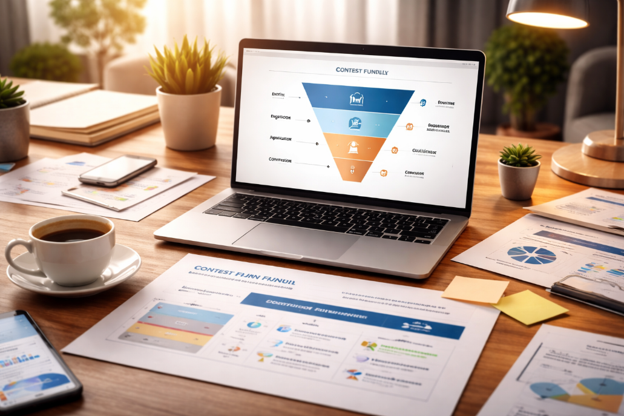
Designing a Multi-Phase Contest Funnel That Converts in 14 Days

Most contests collect attention, yet very few generate revenue with multi-phase contest funnel. In fact, many campaigns achieve 20–40% opt-in rates, but fewer than 5% of participants convert into buyers. The issue is not traffic volume; instead, it is structural design.

Brands focus on maximizing entries, and as a result, they fail to engineer buying decisions. However, a contest can become profitable when it operates inside a controlled 14-day decision cycle.

14 days creates enough time to qualify intent, reinforce product exposure, and introduce urgency, while still maintaining attention. This framework builds a structured conversion pipeline.

Revenue Architecture: Define the Purchase Outcome Before Launch


A contest without a defined purchase target becomes a lead list. Therefore, before building mechanics, prizes, or bonus actions, you must define the exact revenue action the campaign is designed to produce. Otherwise, engagement metrics will look strong, yet sales impact will remain weak.

Identify the Primary Conversion Action

First, clarify what “conversion” actually means inside this funnel. It must be singular and measurable.

  • Direct sale for lower-ticket products
  • Pre-order for limited launches
  • Booking or consultation request for high-ticket services
  • Subscription activation for recurring models

Next, calculate the average decision cycle of your product. If your product typically requires three meaningful exposures before purchase, the contest must deliberately create those exposures.

Additionally, define the minimum number of product interactions required before a participant becomes sales-ready. Without this clarity, urgency in Days 11–14 will feel forced.

Reverse-Engineer the 14-Day Timeline

Once the outcome is defined, structure the timeline backward.

  • Days 1–3: capture segmentation data and initial intent signals
  • Days 4–7: evaluate behavioral qualification through tracked actions
  • Days 8–10: reinforce product positioning and familiarity
  • Days 11–14: deploy structured conversion triggers

This sequencing ensures that urgency is earned through qualification, not rushed prematurely. As a result, the closing window feels logical rather than aggressive.

Set Performance Benchmarks

Finally, define performance targets before launch so evaluation remains objective.

  • Revenue per 1,000 participants
  • Engagement score threshold required for offer exposure
  • Target purchase rate within 14 days

When these metrics are set in advance, the contest stops being an experiment and becomes a measurable revenue system.

Phase 1 (Days 1–3): Entry Structure That Captures Intent Signals

Phrase 1 of the multi-phrase contest funnel

Entry design determines downstream conversion power. If you only ask for name and email, you collect contacts. However, if you design the entry correctly, you collect purchase indicators.

Build a Segmented Entry Form

Your entry form must quietly qualify participants while still feeling simple. To achieve that balance, include fields that map directly to buying probability.

  • Product interest selection
    Ask participants which product category interests them most. For example: “Which collection are you most interested in?” Each selection becomes a product-interest tag inside your CRM. Later, your emails can show only relevant SKUs instead of generic promotions.
  • Budget bracket
    Include 3–4 price ranges. For example: “What price range are you considering?” This answer becomes a price-sensitivity tag. High-budget participants should not receive discount-heavy messaging early.
  • Purchase timeframe
    Ask: “When do you plan to purchase?” Options such as “Within 2 weeks,” “Within 1 month,” or “Just exploring” create a time-intent tag. This tag will heavily influence who receives the Day 11–14 offer.
  • Use-case context
    Clarify why they want the product. Gift? Personal use? Upgrade? This becomes a motivation tag, which shapes your messaging tone.

Every answer must automatically attach to the participant profile as a structured CRM tag. Do not store it as plain text. You need filters, automation triggers, and segment logic. Otherwise, the data becomes useless.

Introduce Progressive Qualification

If you ask too many questions upfront, completion rates drop. Therefore, structure the entry in layers.

  • Step 1: Email and first name. Low friction. High completion.
  • Step 2: Product interest and timeframe. Behavioral qualifier.
  • Step 3 (optional): Budget or use-case. High-value signal capture.

For example, if someone selects “purchase within 2 weeks,” you can unlock a small bonus entry in exchange for answering the budget question. That incentive protects completion rate while increasing signal quality.

This structure allows you to collect meaningful intent data without overwhelming participants.

Apply an Early Scoring Model

Once data is collected, assign weighted value immediately.

Example scoring logic:

  • Purchase within 2 weeks = +10 points
  • Budget above mid-tier = +8 points
  • Product-specific interest = +6 points
  • “Just exploring” = +1 point

Then define clusters:

  • High intent: 18+ points
  • Medium intent: 8–17 points
  • Low intent: 0–7 points

By Day 3, you already know who deserves stronger messaging later. That clarity prevents wasted communication and protects your closing window.

Phase 2 (Days 4–7): Behavioral Qualification Based on Product Interaction

Phrase 2 of the multi-phrase contest funnel

Entry answers show declared interest. However, actions show real intent. Therefore, Phase 2 must focus on observable behavior tied directly to product exposure.

Track Product-Specific Actions

Inside your gamified platform, connect bonus entries to product-driven behavior.

Examples:

  • Bonus entry for visiting a specific product page
  • Bonus entry for watching 75% of a demo video
  • Bonus entry for using a configurator
  • Bonus entry for adding a product to wishlist

Each action must trigger an event tag inside your CRM. Use tracking pixels and UTM parameters to connect multi-phase contest funnel actions with website behavior. Without this connection, you cannot measure real engagement.

For example, if a participant watches the demo video and returns the next day to view pricing, that pattern signals elevated purchase readiness.

Establish a Depth-of-Interest Score

Now refine the scoring system using behavioral signals.

  • Time on product page above 90 seconds = +5 points
  • Repeat visit within 48 hours = +7 points
  • Exploring multiple product variations = +6 points
  • Single shallow visit under 10 seconds = 0 points

These weighted actions create a depth-of-interest score. As a result, you move beyond entry answers and focus on demonstrated engagement. Importantly, do not overvalue one action. Purchase probability increases when multiple signals combine.

Promote High-Intent Participants Into a Priority Segment

By Day 6 or 7, combine entry score and behavior score.

Set clear promotion rules:

  • Total score above 25 points → move to priority conversion segment
  • Two repeat product visits within 72 hours → auto-upgrade
  • Email click + product interaction within 24 hours → escalate tier

Additionally, set engagement frequency triggers. If someone interacts three times in four days, they deserve stronger messaging. Conversely, silence indicates lower readiness.

This structured promotion ensures that by the time Phase 3 begins, your messaging intensity matches real buying probability.

Phase 3 (Days 8–10): Structured Product Reinforcement

Phrase 3 of the multi-phrase contest funnel

Before a purchase offer appears, familiarity must increase. At this stage, you are not pushing a discount. Instead, you are strengthening confidence. Participants must feel informed, reassured, and mentally committed. Therefore, Days 8–10 focus on controlled reinforcement built around behavioral tiers.

Use Micro-Commitments to Increase Buying Probability

Large decisions feel risky for some of the best market trends. However, small actions reduce friction. That is why micro-commitments matter.

Encourage actions such as:

  • Download a buying guide tailored to their selected product category
  • Compare product variations inside an interactive chart
  • Save a personalized configuration for later access

For example, if someone configures a product size or selects features, that action signals psychological ownership. Consequently, the probability of purchase increases. Additionally, each micro-action should add incremental score weight. If a participant downloads a guide and saves a configuration within 48 hours, that pattern deserves escalation.

Deploy Tier-Based Email Sequences

Now your segmentation begins to work for you. Every tier must receive messaging aligned with its intent level.

  • High-intent participants:
    Send direct positioning emails. Highlight product benefits, testimonials, and practical outcomes. Keep messaging concise and decisive.
  • Mid-intent participants:
    Provide educational reinforcement. Address common objections, explain comparisons, and clarify use cases. Build clarity before urgency.
  • Low-intent participants:
    Trigger a reactivation prompt. Offer a helpful resource, ask a question, or highlight a popular product choice. The goal is re-engagement, not pressure.

Spacing matters. Send no more than one focused message every 24 hours during this stage. As a result, familiarity grows without fatigue.

Introduce Controlled Scarcity Signals

Scarcity must feel earned. Therefore, introduce it gradually.

  • Limited-time bonus entry multiplier for completing a product action
  • Early-access positioning for top scorers
  • Inventory visibility signals such as “limited units available” when accurate

Avoid exaggerated urgency. Instead, align scarcity with behavior. If someone shows strong engagement, tell them they are among the first eligible for early access. That framing reinforces exclusivity while maintaining credibility.

Phase 4 (Days 11–14): Conversion Trigger Strategy

Phrase 4 of the multi-phrase contest funnel

The final stage compresses urgency and segmentation. At this point, participants have been qualified, reinforced, and scored. Now, your offer must match their readiness.

Segment-Specific Offer Deployment

One offer for everyone weakens performance. Instead, deploy targeted incentives.

  • High-intent segment:
    Offer a concise, exclusive incentive such as early access or a premium add-on. Avoid deep discounts if price sensitivity is low.
  • Mid-tier segment:
    Provide bundled value. For example, combine the product with a complementary bonus. This reduces hesitation.
  • Low-tier segment:
    Send a clear deadline reminder with a modest incentive. Keep it simple and direct.

Each offer should reflect prior behavior. If someone viewed a specific product twice, reference that product directly. Personalization increases response rate.

Escalation Cadence Across Final 72 Hours

Urgency must intensify in structured steps.

  • 72-hour notification: Announce the offer and remind participants of their qualification status.
  • 48-hour reinforcement: Highlight benefits and reinforce scarcity signals.
  • Final 24-hour push: Clear deadline, strong call-to-action, minimal distraction.

Avoid excessive repetition. Each message must add new context or reinforcement.

Retargeting Alignment With Behavioral Data

Parallel to email, activate paid retargeting audiences based on real engagement.

  • High-score audience: Show product-focused ads with direct offer messaging.
  • Product viewers: Display dynamic ads featuring the exact product viewed.
  • Email clickers who did not purchase: Reinforce deadline urgency.

Sync CRM score segments with ad platforms daily during this phase. This alignment ensures that your most engaged participants see consistent messaging across channels.

By Day 14, the funnel is no longer a contest. It is a structured revenue engine that has guided qualified participants toward a defined purchase action.

Data Signals That Predict Purchase Probability

Multi-phase contest funnel data signals

Multi-phase contest funnel data must translate into revenue projections. Otherwise, engagement metrics remain cosmetic.

Weighted Behavioral Scoring Model

Every tracked action must carry a predefined weight tied to purchase correlation. For example, product page visit = 5 points, repeat visit within 48 hours = 8 points, configurator completion = 12 points, email click = 4 points, cart view = 15 points.

A participant’s Total Intent Score (TIS) equals the sum of all actions:
TIS = Σ (Action Weight × Frequency).

Next, apply segment multipliers using historical data. If high-intent clusters convert at 12%, mid-tier at 5%, and low-tier at 1%, those percentages become operational benchmarks tied to score thresholds.

Revenue Forecasting Before Campaign Ends

Use a clear projection formula:
Projected Revenue = Segment Size × Expected Conversion Rate × Average Order Value (AOV).

For example, 250 high-intent participants × 12% × $150 AOV = $4,500 forecasted revenue. By Day 10, this model provides a data-backed revenue expectation rather than a post-campaign surprise.

Conclusion

A multi-phase contest funnel becomes profitable only when it operates as a structured 14-day conversion system. First, you define the purchase outcome. Then, you collect intent data, score behavior, reinforce product familiarity, and finally deploy controlled urgency based on qualification.

Every phase builds on the previous one. As a result, the campaign stops being a giveaway and starts functioning as a measurable revenue engine.

When segmentation, scoring, and timing work together, participants move through a deliberate path that increases purchase probability within two weeks.

Frequently Asked Questions

How long should a multi-phase contest funnel run to drive real conversions?

Fourteen days works well because it balances attention and urgency. It allows time for qualification, reinforcement, and escalation without losing participant focus.

What is the most important part of a multi-phase contest funnel?

The scoring and segmentation structure is critical. Without it, every participant receives the same messaging, which weakens conversion performance.

How do I know if someone is high-intent during the campaign?

Track repeat product visits, configurator use, and email engagement. When multiple high-weight actions combine, buying probability increases significantly.

Should every participant receive the same offer at the end?

No. High-intent participants often need exclusivity, while mid-tier segments respond better to bundled value. Offer structure should reflect behavioral score.

How can I forecast revenue before the contest ends?

Use the formula: Segment Size × Conversion Rate × AOV. Apply historical conversion benchmarks to each intent tier to estimate expected revenue.

What happens after Day 14 if someone does not purchase?

Move them into a long-term nurture sequence based on their intent tier. Continue reinforcing product relevance while reducing urgency pressure.

Why Traditional Lead Generation Struggles to Hold Attention and What to Do About It

Mass emails, banner ads, cold calls – all the classics are starting to blend into background noise. People don’t reject them outright. They just stop noticing them. Cold calls barely register anymore. Most emails never get opened. Not because the channels are broken, but because attention is. At the same time, the average cost of one lead across different industries is about $198, and companies generate around 1877 leads each month. Attention has become the scarcest resource in marketing. And it’s getting more expensive to earn every year.

At the same time, the problem is not in lead generation itself, but in how it is implemented in practice. The modern user expects personalization, relevant content, and interactivity. Today, we will break down why traditional methods have lost their relevance and offer a number of strategies that will help you retain audience attention and increase conversion.

The Attention Crisis in Modern Lead Generation

Marketing isn’t short on tools; it’s short on attention. Email newsletters, cold calling, and banner ads are capturing and holding the audience’s attention less and less often. People scroll, swipe, close, ignore – all within seconds. Not because your message is bad, but because there are hundreds of others competing with it. The average open rate for marketing emails worldwide is about 32%. And the average click-through rate is only 1.4%. All of this indicates that most users do not interact with your advertising messages at all.

This isn’t just ad fatigue. The problem runs deeper and is rooted in how people consume information today:

  • An excessive number of informational signals. Social media, messengers, pop-up notifications. It is simply impossible to process all incoming information, and as a result, users begin to ignore a large flow of messages to cope with the overload.
  • Declining trust in traditional advertising. Fewer and fewer users consider standard advertising formats relevant. More and more people use ad blockers, which is reflected in reach.
  • Changes in user behavior. The modern user prefers mobile devices, social media, and short videos. Therefore, long texts or cold commercial messages simply push them away.

Common Pitfalls of Traditional Lead Generation

Most lead gen problems aren’t new. Companies keep repeating the same mistakes and wonder why results stall. We have also provided examples so that you understand how each of these missteps “kills“ the attention of a potential customer.

Using Outdated Scripts and Templates

Templates save time, but they also scream, “This wasn’t written for you.“ And people feel that instantly. This “mass text“ effect reduces interest in the advertising and triggers rejection even before the dialogue begins. For example, cold calls annoy people. In practice, cold calling often requires up to 18 calls of attempts just to get a reaction, which explains why response rates keep falling.

Ignoring Personalization

If you send the same messages to everyone, be prepared for them to go unanswered. A potential customer will not respond to your mailing because they will not see anything useful or relevant for themselves in it. In B2B, poor segmentation quietly turns leads cold before any real conversation even begins.

Lack of a Multichannel Approach

If a business relies on only one advertising channel, for example, only calls or email marketing, it automatically loses part of the audience. Buyers don’t live in a single channel; they move between platforms throughout the day, and brands that show up in only one place are easy to miss. If you do not meet the needs of the audience, you remain unnoticed.

Overly Aggressive Sales

Aggressive sales pressure early on rarely accelerates decisions and more often pushes potential customers away. Potential customers shut down and leave. Too much pressure, especially in cold mailings and calls, leads to rejections and loss of loyalty.

It is worth noting that the listed mistakes are not uncommon even among experienced marketers. To fix the situation, modern companies are increasingly shifting to smart and personalized approaches. When generating leads, they pay special attention to the value of messages and a respectful tone in communication with customers.

Why Attention Matters More Than Ever

In practice, attention has become one of the clearest indicators of whether marketing efforts will lead to revenue at all. If a potential customer is engaged, they are highly likely to become your buyer. And it is a completely different situation with those who did not keep their eyes on your ad for at least a second. According to statistics, 79% of leads never convert into sales without ongoing interaction and nurturing campaigns that are able to maintain interest at different stages of the sales funnel. In simple terms, without intentional retention, 4 out of 5 of your potential customers will simply disappear from the funnel.

Why is this important? When a person shows interest in your product, for example, subscribes to a newsletter or leaves their contact information, it does not guarantee a purchase. If the content that follows turns out to be irrelevant, without value and engagement, leads will lose interest and leave.

Modern Strategies to Capture and Keep Attention

Markets today reward relevance, timing, and consistency, not louder messages or higher frequency alone. Below you will find effective strategies that will work where traditional methods no longer deliver results.

Personalization and Segmentation

Personalization works because it respects context: behavior, intent, and timing, rather than treating every lead the same. A modern company must implement personalization for leads based on customers’ behavior, interests, and geographic data. Personalized companies increase revenue by an average of 10–15%, and in some cases, the figure reaches 25%.

Interactive Content

This is not just text or an image; these are elements that engage the customer in action. Bright examples are quizzes, surveys, ROI calculators, assessment tools, or interactive tests. With this approach, your customer stops being a passive viewer and becomes an active participant, which increases engagement. Practice shows that implementing gamification in social media can increase engagement by almost 60%.

Multi-Channel Approach

A multichannel approach allows brands to stay visible across touchpoints without forcing users into a single communication path. To avoid losing attention, you must be where your audience is. Good companies combine activity on social media, messengers, and mobile apps with classic email campaigns. As a result, it becomes possible to create a continuous interaction journey and “reach“ the customer where they are most active.

Storytelling and Value-Driven Messaging

Stories work because they translate value into real situations, helping potential customers see themselves in the outcome rather than in the pitch. Instead of dry facts and standard advertising promises, use stories about how your product helped real customers. This way, you can create an emotional connection and increase trust in your company. This approach is called storytelling; it replaces aggressive advertising with narrative. It inspires and holds attention.

Tools and Technologies That Help

To effectively attract and retain the attention of leads, modern marketers use not only ideas and strategies but also advanced tools and technologies. With their help, it becomes possible to automate processes, improve analytical visibility, and enhance the quality of interaction with potential customers.

CRM Systems (Customer Relationship Management)

Personalization will break down without a CRM. Consistent follow-up depends on remembering who the lead is and what they interacted with. CRMs simplify interaction management and optimize the sales process. Examples of CRM systems: HubSpot CRM for small and medium-sized businesses and Microsoft Dynamics 365, a powerful enterprise CRM with analytics and AI tools for large teams.

Marketing Platforms and Automation

Automation platforms matter not because they send emails, but because they allow timely follow-ups at scale. These tools become the foundation for personalization and follow-up communication with leads, which is important for retention at every stage of the sales funnel.

Chatbots and Live Chat Platforms

Chatbots help interact with visitors to your website. They perform initial lead qualification based on clarifying questions and 24/7 data collection. A chatbot can be used in a messenger app, on a website, or on social media.

Analytics and Data Visualization Tools

You need data to understand what works (and what doesn’t). Web analytics, such as Google Analytics, are used to monitor the activity of the users on your site. You can keep track of the amount of time they use on the pages of your site, what they do and at which point they lose interest. We also suggest the use of visualization such as Power BI or Tableau. Their assistance will simplify the creation of reports and forecasting future trends.

How to Measure Success?

Want to know whether the new lead-generation strategy works as intended? You need to measure and interpret the results. Below are the key metrics:

  • CTR (Click-Through Rate). It is the percentage of people who clicked on an ad. In Google Ads campaigns, the average CTR is usually 1–2%. On social media, it’s around 0.5–2%. If the rate is lower, you need to improve the content.
  • Dwell time. The time spent on a website or content. The longer a person stays, the more engaged they are. That means the higher the likelihood that they will become a lead or a customer.
  • Conversion Rate (CR). The percentage of users who completed a target action (left contact information or made a purchase) out of the total number of visitors. A high rate is a sign that the audience is engaged.
  • ROI (Return on Investment). A measure of return on investment, how profitable your marketing investments are. It helps evaluate which channels and approaches generate profit and which have no value.

Conclusion: Where Lead Generation Breaks – and What Actually Fixes It

Traditional lead generation methods are now less effective because they lose the most important thing – the audience’s attention. Generic messages no longer create lasting interest among users. Now, the key to success is personalization, interactivity, and a focus on value. Study new strategies, experiment with formats, segment your audience, and test approaches. Only this way can you turn interest into real value and sales.

Measuring Success: KPIs & Analytics for Promotions

A contest that gets thousands of entries might look like a win. But if those leads never open an email, never click through, and never buy, what did you actually gain? 

Many brands launch promotions without defining what success looks like. They chase vanity metrics like entry counts or social shares and call it a day. The problem is, none of that matters if it doesn’t move the business forward. 

This article is about moving past surface-level stats. You’ll learn how to track the metrics that actually matter, optimize your campaigns based on real data, and prove ROI to stakeholders with confidence. 

Define Success Before Launch: Choose the Right KPIs 

If you don’t define success before your contest goes live, you won’t know whether it worked. Every promotion should begin with one question: what is the actual goal? 

Are you trying to generate leads, collect user-generated content, increase trial signups, or drive direct sales? The purpose of your contest should dictate the metrics you track, not the other way around. 

Match Goals to Funnel Stages 

Top of Funnel Goals
If you’re focused on reach and awareness, measure: 

  • Entry volume
     
  • Referral rate
     
  • Social media engagement or impressions
     

Mid-Funnel Goals
If you want to assess engagement and lead quality, track: 

  • Email open and click rates
     
  • On-site behavior like time on page or scroll depth
     
  • Content engagement for UGC-focused campaigns
     

Bottom of Funnel Goals
If revenue is the goal, focus on: 

  • Sales lift during and after the promotion
     
  • Conversion rate from entries to purchase
     
  • Cost per acquisition compared to other marketing efforts
     

Bonus Tip: Set Benchmarks 

Use data from past campaigns or reliable industry standards to set realistic expectations. If a previous contest converted at 8 percent, that becomes your starting point for optimization. 

KPIs should always align with your business goals. A contest is more than a fun idea. It’s a strategic tool — and with the right metrics in place, you can measure what matters. 

Track Engagement and Conversion Metrics in Real Time 

Running a contest without live performance tracking is like flying blind. You need to know what’s working as it happens so you can adjust, optimize, and get the most out of your promotion. 

Start by setting up the right tools. Use Google Analytics, Meta Pixel, UTM parameters, and a campaign dashboard to track traffic, behavior, and attribution across channels. If possible, connect your CRM or email platform to monitor post-entry engagement. 

Key Engagement Metrics to Monitor 

These tell you how well your contest is capturing attention and prompting action: 

  • Entry completion rate — how many people start and finish the form
     
  • Referral actions — how many participants are sharing the contest
     
  • Repeat participation — users returning to spin again, share again, or check results
     
  • Social shares — how often your campaign is shared on platforms like Instagram or Facebook
     

Key Conversion Metrics to Track 

These show whether your contest is actually leading to revenue-generating actions: 

  • Opt-in to purchase conversion — how many people who entered also bought something
     
  • Cart adds from contest traffic — a strong indicator of intent
     
  • Email signups to sales — track how well new leads convert through your follow-up sequences
     

Bonus Tip: Visual Behavior Tracking 

Use heatmaps and scroll depth tools like Hotjar or Microsoft Clarity to see how users interact with your landing page. This helps identify where users are bouncing or losing interest so you can refine your layout or copy mid-campaign. 

Real-time metrics aren’t just for reporting. They’re for making smarter decisions while your contest is still live and active. Keep a close eye, and be ready to pivot. 

Measure Lead Quality and Long-Term Value 

A big email list looks impressive. But if none of those contacts convert or stick around, what did you actually gain? 

Contests often generate a surge in signups, but not all leads are equal. The real value lies in identifying which participants are worth nurturing and which ones are just in it for the free stuff. 

Don’t Just Count Leads — Qualify Them 

Start by segmenting your list. Use entry source, quiz responses, referral activity, or form data to group participants by behavior or interest. Then track how each segment behaves over time. 

Look for signs of long-term engagement, such as: 

  • Repeat purchases
     
  • Newsletter engagement
     
  • Loyalty program signups
     
  • Friend referrals
     
  • Participation in future campaigns
     

This helps you prioritize high-quality leads who are more likely to convert again and again. 

Calculate Customer Lifetime Value (CLV) 

To understand the true ROI of your contest, calculate the CLV of entrants using this formula: 

Average order value × purchase frequency × retention time 

Compare this figure to your average site visitor or paid ad lead. If your contest leads have a higher CLV, that’s a sign your promotion is attracting the right kind of audience. 

If the CLV is lower, consider tightening your entry mechanics or prize targeting in future campaigns to filter out low-intent participants. 

The goal isn’t to get the most entries. It’s to get the best leads. Focus on long-term value, and your contests will become a smart acquisition tool instead of a short-term traffic spike. 

Prove ROI with Attribution and Reporting 

To justify the time and budget spent on contests, you need to show clear results. That means tying your campaign directly to revenue, not just reach. Attribution and reporting are how you move from “this got a lot of entries” to “this drove real business growth.” 

Track the Journey from Entry to Purchase 

Start by setting up proper attribution tools: 

  • Use UTM codes on all contest links to track source and behavior
     
  • Assign unique referral IDs to participants who share the campaign
     
  • Tag users in your CRM based on the campaign name and entry method
    This allows you to follow each lead from the moment they enter to the point they take meaningful action, like making a purchase or joining a loyalty program.
     

Attribute Sales Lift and Conversions 

Once the campaign ends, compare your performance before and after. 

  • Did sales increase during or immediately following the contest?
     
  • Did new leads convert at a higher or lower rate than your usual traffic?
     
  • Are email open and click-through rates stronger than average?
     

By tracking these patterns, you can isolate the contest’s impact and report it accurately. 

Build a Reporting Framework Stakeholders Will Trust 

When presenting results, go beyond vanity metrics. 

  • Highlight key KPIs that tie directly to business goals
     
  • Show the cost to acquire each lead versus the revenue they generated
     
  • Use simple charts or graphs to visualize growth in site traffic, email list size, or sales volume
     

Conduct a Post-Mortem to Improve Future Campaigns 

Every campaign should end with a debrief. 

  • What worked well?
     
  • What didn’t deliver as expected?
     
  • What should you test or change next time?
     

When you approach contests with this level of discipline, you’re not just running promotions. You’re building a performance system your stakeholders can trust. 

Optimize Using A/B Testing and Iteration 

A contest should never be treated as a one-time launch. The most effective brands treat every promotion as a learning opportunity. With the right testing strategy, each campaign becomes smarter, more efficient, and more profitable than the last. 

Test What Matters Most 

Not every element needs to be changed at once. Focus on the variables that directly affect engagement and conversion: 

  • Headlines and calls-to-action
    See which phrases grab attention and drive clicks
     
  • Entry mechanics
    Compare formats like spin-to-win, quizzes, or refer-a-friend models
     
  • Prize structure
    Test whether big-ticket rewards outperform tiered or surprise incentives
     
  • Timing or duration
    Experiment with campaign length, entry windows, or launch days
     

Run A/B Tests During the Campaign 

If possible, test live elements such as: 

  • Subject lines in email promotions
     
  • Social ad creatives and copy
     
  • Landing page layouts or headline variations
     

Use a single variable per test so you can clearly measure impact. 

Build a Feedback Loop 

Once the campaign ends, analyze what worked and what didn’t. 

  • Which version of your contest converted more leads?
     
  • Did certain ad formats outperform others?
     
  • Were there specific days or channels that drove more qualified traffic?
     

Document your takeaways in a “what we learned” section of your campaign report. This creates a clear knowledge base that informs the next promotion — and helps avoid repeating mistakes. 

Contests don’t need to be perfect out of the gate. They need to be tested, refined, and improved. When you treat them as evolving systems, your ROI improves with every iteration. 

Conclusion: ROI Isn’t a Guess — It’s a System 

A successful contest is not just about participation. It’s about outcomes. It’s about understanding what to track, how to track it, and how to use that data to make smarter marketing decisions. 

Too many brands stop at surface-level stats like entries and likes. But real growth happens when you dig deeper — when you measure lead quality, lifetime value, conversion rates, and post-campaign impact. That’s where the true ROI lives. 

When you build contests with clear KPIs, solid attribution, and a plan for iteration, each campaign becomes more effective than the last. You’re not just running promotions. You’re building a repeatable growth engine. 

If you want help designing a sweepstakes campaign that delivers real, measurable value, Content Factory is ready to help. We don’t guess. We build systems that scale. 

2023 Marketing Initiatives: Adapting to the Changing Values of Customers

2023 Marketing Initiatives: Adapting to the Changing Values of Customers

When you consider what marketing covers, you often don’t recognize how far the marketing reach is. It is everything that influences a customer – it reaches far beyond advertising. It’s the entire experience of brand, pricing, customer service, engaging experience, and more. After the most recent years of transactions, consumer behavior as well as merchant services has taken a real dive into how to pivot while facing extreme challenge. Most businesses worked hard to meet the demands to stay in business – fairly remarkable. And during the pandemic, while consumers and businesses learned the new normal, plenty of families also re-evaluated their needs and changed. There are significantly fewer 2nd income earners in families today than 2020. Getting back to basics and priorities really hit home during this global challenge for obvious reasons. And it’s here to stay. This is why 2023 marketing priorities look different than most years.

One of the many changes in behavior over the pandemic led to the customer demand of having customer service employees that are knowledgeable and supportive for the service being offered.  While many people have decided not to go back to work, it leaves the business in the lurch – and now customers are more demanding, wanting the people present to really care for their job, service, and brand they support. Bad employee attitude is the number one, unacceptable behavior for what drives customer to leave a brand. This is a testimony to personality testing, and really spending time getting to know your potential front-line team in an interview – it can cost the business much more than employee turnover as the customer acquisition cost gets lumped on top of that. This reason is closely followed by 3 other similar issues:

  • Unfriendly service
  • Untrusted company
  • Unknowledgeable employees

It looks like consumers did some looking inside during the pandemic to decide what really matters to them; getting back to human basics really were revealed. Consumers want service folks to be committed to their job, try hard, and deliver good service based on these principles. After all, these are founding principles of the American dream of opportunity – hard work pays off.  73% of people say that customer experience is an important factor in their buying decisions, but currently only 49% of US consumers say that today’s companies provide a good experience.


Visual Learning

Visual Learning is another trend that has staying power. We have learned a lot from infographics – it’s a communication tool that combines images and data to tell a story; women prefer reading and men prefer, images; therefore you are capturing 100% of your audience while providing data and content that is easy to consumer.  Visual storytelling also can use color which elicits positive emotions from people. Impacting emotion during your storytelling is the very basics of marketing – impact your consumer. Visual assets can be delivered in many formats, from slideshows to infographics, to sell sheets, and video story telling. Research shows that consumers are 85% more likely to buy your product after watching a video about it. That’s a compelling stat.


Personalization

Personalization is another trend that gets more interesting as technology evolves. It started with merely using a customer’s name and offering them a birthday gift. Now technology is enabling a lot more with personalization. From buying history and artificial intelligence in eCommerce to in-person, AI – the ability here is growing vastly. Users expect that brands know who they are and that they treat them as this same person across platforms, from ecommerce, to in store, and kiosk locations. Quick service restaurants are leveraging kiosks to enable service while there’s employee shortages. The kiosks have proven to be a very successful option from both the merchant side and the consumer side. Consumers have claimed they prefer kiosks so they may keep control of their order, understand all the personalization options, and ensure their order is accurate. Kiosks also offer up-sells and cross sells reliably, whereas humans do their best but ultimately are not as reliable as computers. Additional AI being used enables the kiosk to recognize the consumer using a camera and retrieve their past order, offer additional items that consumers also enjoy with this selection, and show their loyalty points and offer. This experience is being widely appreciated by consumers and adding to the average ticket by up to 40% in some QSR locations.


Conversational Marketing

Conversational Marketing is another trend that consumers are demanding – they want to have conversations and not be talked at. The idea that they are a part of the conversation gives the consumer the acknowledgement they want. Years ago, sales folks addressed consumers as sir or mam and now they are chatting with them at the sales counter asking about their kids – and when online they are chatting with them about how they can help and adding the friendly touch of how are you today, what will you be using this product for? This informal approach makes the brand human and shows how they care for the buyer and actually engage. Data gathered here is also valuable as consumers will disclose more when having a conversation versus processing a transaction.  These learnings can be used in future opportunities with the consumers. Tracking and saving this data in your CRM is key.

Product Launch Checklist: Watch Your New Product Sales Soar

Launching a new product is one of the most exciting parts of owning a business, but it can also be the most stressful. Arming yourself with a product launch checklist is the best way to stay on course and ensure your product release is only overwhelming as a success.

Your product launch checklist will serve as the blueprint for your project, breaking it down into manageable tasks to establish workflow, assign responsibilities across your team, and prepare for potential weak links. Your checklist can also be used to capture best practices and lessons learned for your future endeavors.

If this sounds like one more thing to add to your list, don’t worry. Here is a 14-step guide that will get you ready for a launch that is destined for success.

  1. Define your target audience
    Identify your ideal customer with detailed descriptions of their goals, motivations, and pain points. This information is crucial for developing a product that will meet their needs and will also guide your marketing strategy and PR activities.
  1. Detail product design & features
    Draft your design and describe the features that differentiate your products from the competition. Provide designers with the specifications and documentation needed to start the development process.
  1. Dial-in your pitch 
    Create your Unique Selling Proposition– a clear, concise “elevator pitch” that communicates who your product is for, what it does, and why people should buy it.
  1.  Map out your marketing strategy
    Develop an overarching marketing and media plan to promote the launch and support continued marketing efforts. Create a calendar outlining dates and person responsible to maintain publicity momentum.
  1. Leverage social media channels
    Use all targeted social media channels to engage your audience well before the launch. Make sure to recruit everyone in your network and friends to spread the word and create contests and incentives to expand your following.
  1. Develop product marketing copy & training documentation
    Develop creative content for your website, blog posts, launch emails, and social media posts. Finalize all product documentation for feature descriptions, instructions, technical datasheets, FAQs, etc., and translate for relevant audiences if necessary.
  1. Finalize product packaging
    Design and order physical or digitally rendered packaging for your product. Make sure to compile and send the design team all necessary colors, images, logos, and fonts specific to your branding.
  1. Update & integrate software
    Select your email service provider and stress-test every potential touchpoint to capture data and customer contact information (newsletter signup form, for example).
  1. Update website
    Update your website to showcase the featured product and ensure there is a clear and easy pathway to the purchasing page.
  1. Set up payment processing
    Integrate billing and payment options and functionality to accommodate an efficient, stress-free purchasing experience.

    Research reveals the top reasons people abandon their shopping cart include discount codes not working, orders taking a long time to ship, and having to re-enter credit card information or shipping information.

  2. Dial-in order fulfillment details
    Select shipping and delivery options for your new product and test to ensure fast, reliable order-fulfillment. Consider your audience when choosing the shipping method and make sure all extra costs are transparent.

    “63 percent of respondents stated they had abandoned shopping carts due to the cost of shipping.”

  1. Schedule press & media releases
    Develop a professionally written press release. Reach out to your network and relevant media outlets to find out submission dates and guidelines that sync up with your launch date.
  1. Recruit partners & affiliates
    Collaborate with partners, affiliates, and other potential influencers to help promote the launch and sell your product. Consider if your product is a good fit for established shopping sites like Amazon, Rakuten, Walmart, Jet, or other relevant marketplaces.

    According to recent studies, 80% of advertisers have affiliate programs, almost 50% of Twitter users rely on influencer reviews before buying a product, and 40% of Twitter users purchased an item after seeing a tweet by an influencer.

  1. Solicit feedback
    Implement tools to survey users for product feedback and solicit testimonials from customers. Gather your team to assess what worked and what didn’t. And don’t forget to celebrate!

A smooth product launch results in happy customers and internal team members. But you can’t get there without a map to guide your course. Follow these 14 steps, and you will be celebrating the results, as well as the means you took to get there.


Reframing: Change their minds, Win their Hearts

In our previous post, we introduced the power of framing communication– spinning your messaging to make it more effective and relevant for the specific audience you’re targeting. Since our frame of reference dictates what we pay attention to, how we feel, and what actions we take, controlling how you frame your communication will control your customers’ subsequent experience.  Now we’re discussing the follow through on pre-framing with reframing.

Ideally, you want to set the stage by pre-framing your communication with customers: anticipating and re-working their perception of your brand to facilitate the best possible experience.

But there are going to be times when you will find yourself on the defense or in a position where you have to re-frame the focus of your communication from a negative to a positive.

Look at This Way

Re-framing is the art of changing someone’s perspective by attaching a different meaning to an object or situation, usually with the aim of getting them to adopt your point of view. This can be an incredibly effective marketing technique to distinguish your product or services from the competition or transform a seeming liability into an asset.

Let’s say, for example, that you’re promoting a new line of athletic running tights. You’ve chosen the color blue as a way to stand out from other brands, even though black is still the preferred color. You know your target audience consists of young to middle-aged, fit women who value fashion and style as much as quality and function. So how do you re-frame the color blue as a desired attribute when most women still prefer the versatility and slimming effect of black leggings?

One way would be to re-frame the more popular color black as “status quo and mediocre.” You could create an ad with a woman leading the pack- her strong legs dressed in blue whizzing by a sea of black limbs, thus inspiring a sense of strength and beauty through individuality.

You can also use re-framing to avoid directly competing with a company that might have a perceived advantage over you, shifting the focus to your strengths. For example, if your main competitor has been around for decades and offers a lower rate for their services, you could commend them for finding a formula that works for a certain population. Then you launch into how your approach was created for a select clientele who desire a highly-skilled, personalized experience using cutting edge technology.

The Art of Persuasion

The concept of re-framing may seem simple, but just like any communication technique, it requires skill and a bit of finesse. You have to be confident and knowledgeable about what you are selling. And above all, you have to establish trust and rapport with your customers, which requires a clear understanding of their needs, desires, and motivating factors.

Join us in our upcoming blog post for more ways to master communication with the framing effect.

“Powerful and elegant reframing occurs when we reclassify a piece of behavior, experience, or emotion in such a way that it makes even more sense, and leads to much more effective thinking, feeling, and acting.”

                                                                                                                                           – Greg Woodley  


Pre-Framing: How to Win More Customers, Frame by Frame

 “We make meaning from the world around us by taking a limited number of facts and inferring or assuming other details to be able to make sense of things. Reframing leaves the facts alone but may well challenge the assumptions.”   (Changingminds.org)

Framing communication simply means creating new context or “frame” for any given situation to shape or shift its meaning.  The concept is somewhat straightforward, but there is a skill to it, just like with any communication technique. But with a bit of practice, framing strategies will become your most powerful tool for influencing your customers’ experience and behaviors.

There are 3 types of framing: pre-framing, re-framing and de-framing. We’re going to start with pre-framing because if done correctly, it can be the most effective way to remove customers’ doubts and put them in the right frame of mind to take action.

What is it?

Because we are creatures of habit, and skeptical ones at that, companies have to find credible ways to spark trust and curiosity for their new brands and products. Pre-framing presents the opportunity to dispel potential doubts and objections by anticipating the customers’ perceptions and re-working them into the best version possible.

Here are some examples:

I know our competitor claims their software offers the most comprehensive package. But let’s break it down based on what you will be paying for and what you actually need: do you really need the x,y,z feature, or do you really just want something that’s easy to use, painless to install, and will cost you less?

Yes, our estimated date of completion is a few weeks longer, but which is more important to you- getting a high-quality, fully functioning product executed with thorough attention to detail, or getting an incomplete job that will end up slowing you down because you keep having to stop and fix the things that were overlooked?

Grab a coffee to go >> Get energized with a warm cup of coffee that tastes like home.

Sales Associate >> Professional Closer and Revenue Maximizer

The key to pre-framing is to know what your target audience’s predominant
needs and potential objections might be.

How it works

Just like any effective marketing strategy, the first thing you need to know is who your audience is. Once you’ve identified who you’re talking to, you need to frame your messaging accordingly, which means you need to pinpoint the underlying factors that drive them to take action, or not to take action. For example, is your ideal customer basing their decisions on their core values, the financial benefits or loss/gain potential (what they might lose or gain from purchasing/not purchasing)?

Because you don’t want this to happen…

You’re in a meeting with a prospective client and you find yourself suddenly having to defend what you charge when you weren’t even planning on discussing rates yet. You just gave your potential client the upper hand by assuming they wouldn’t ask the obvious and letting them drive the conversation.

Don’t panic, there’s still hope. We’re just going to have to re-frame things a bit.

Stay tuned for more communication techniques that will have you running the show, frame by frame.

5 Essential Tips to Increase Leads with Growth Hacking

The words hack, hacking, or hacker usually bring up a negative connotation when one hears a reference to them. Until recently, the word hack has only been associated with an unknown person breaking into your computer system to steal private information and using it in a nefarious manner. But hack, or hacking, is now also defined as a positive shortcut that can help make our lives easier. For example, 10 cooking hacks, or cleaning hacks – shortcuts, tips, and suggestions making the chore at hand faster and easier. But what is growth hacking and how does it relate to business?

Why Growth Hacking?

This is the first in a series to help B2B marketers understand growth hacking and how to apply it to their business. Growth hacking is a data-driven science tool. It functions to increase your audience base, conversion rates, retention, referral, and revenue in a short amount of time without spending a large amount of money.

With growth hacking, you’ll learn valuable information about your audience and their buying behaviors, which will help you measure the efficacy of the company’s current marketing strategy. Growth hacking utilizes several methods to improve traffic and improve your online visibility. For instance, Google becomes smarter every day, thanks to the continuous improvement of AI (Artificial Intelligence) capabilities, and Google can now give your site a boost in its rankings based on topics not solely dependent on keyword matching.

So how can your business grow and increase revenue? Let’s begin with the Top 5 Best Growth Hacking tips!

Tip #1: Growth Hacking Tools

One of the first steps is to implement a growth hacking tool. These tools help measure your success, understand your audience, and adjust strategies accordingly. Advances in technology have enabled B2B companies to enhance customer experiences, analyze their customers’ buying behaviors, build nurturing campaigns, and understand what factors influence their purchase decisions.

There are automation tools such as Reply.io that help with business development, account management, inbound/outbound sales, email drip campaigns, and numerous CRM integrations.

Another great tool is Buzzsumo.com. This tool helps find specific keywords, relevant topics, and content that is more likely to engage your customers and encourage them to share your content on their social media platforms. Buzzsumo also allows you to search your competitors to gain insights into what content is working for them and can locate key influencers in your industry that your business can target.

If you are looking for an affiliate program or partner management tool, PartnerStack.com has everything needed to increase traction on reseller and partner marketing programs.

Tip #2: Swap “Contact Us” with Pertinent and Shareable Content

If your B2B business is like most, you probably have a website where customers can research what types of products are offered, the history of your business, and a place to contact you. But is your web traffic being amply converted to qualified leads? If the answer is no, the following tip might help.

Replace the “contact us” fillable form with content from a whitepaper, a case study or data sheet. Content is more enticing than just filling out a generic form. Your customers are likely to have multiple questions. They want to know how your products will enrich their lives, what the benefits are, and why they should buy them. Place this content on your landing page instead of a simple “contact us” form.

Tip #3: Building a Facebook Audience with LinkedIn

Facebook ads are often a key driver for new sign-ups. But how do you attract and build a focused audience to your brand and product? This tactic gives you access to an audience your competitors don’t have on Facebook.

  1. Use your LinkedIn profile to start connecting with people in your industry.
  2. Download and contact your connections from LinkedIn to create a Facebook page customized to that audience by tapping highly targeted content and ads.

Tip #4: Try Before You Buy – The Power of a Freemium

Most customers love a try before you buy, or freemium model. This is an excellent way to entice your customers to try a product or service before they decide to purchase. When implementing a freemium, be sure the offer has enough number of features that the potential customer can consider the benefits of the product and what they stand to gain by purchasing an upgrade to the full product.

Dropbox, the online storage company, is a great example of this try before you buy model. First-time users get the basic service free of charge with the option to upgrade to their premium service for a monthly/yearly fee.

Tip #5: Plan Your Next Campaign with Source Data

Most marketing campaigns are strategically planned and implemented well, but there are some that fall flat when trying to convert leads to revenue. What will benefit your next campaign is using source data to look at which social media channels have the highest conversion rates. With this knowledge, you will know when and on which social channels to promote to. Tools like HubSpot, Marketo, and Google Analytics track and report the channels that have higher conversion rates, making this information valuable for your next marketing campaign.

In Conclusion

In order to grow your B2B company, you need not only online traffic, but more importantly, you need qualified leads to increase conversion, revenue, retention, and referrals. Remember that growth hacking isn’t a one-size-fits-all solution, so you will need to test and retest to analyze which tactics work to help grow your business best.

Psychological Pricing Strategies: Attracting More Sales

When a company comes out with a new product or service, they are harnessing the need for a solution to a problem from their customers. This product may be the next best thing since sliced bread, but how should they go about pricing the product in order to gain an edge over their competition and win the consumer’s sale? Psychological pricing strategies hold the answers.

What is a psychological pricing strategy? It is based on the principle that certain price points trigger our psyche into thinking that a price is much better than it really is.

Psychological pricing strategies:

1.  Buy One, Get One (BOGO)

BOGO is a very popular strategy for driving sales. It can be buying one product at full price and getting the second product at 50% off, or more commonly, buying one product at full price and getting the second product FREE. We as customers love the BOGO concept because it makes us feel that we are getting more for our money. The takeaway is the BOGO plays on our emotional need of getting a better deal than the next guy convincing us to buy multiple items of a product when we may have otherwise only bought one, or even none at all. BOGOs are usually implemented to clean out excess inventory and/or to create a large cash flow.

2.  Odd or Charm Pricing

What is “charm pricing” or “odd pricing”? This strategy is when a product’s price is reduced by one dollar or one penny, creating a price ending in the odd numbers “9” or “99”. When we see a price of $9.99 instead of $10.00, our brain sees the $9.99 price as a more attractive bargain than the rounded-up, $10.00 even price. While the seller loses a penny for each sale, they more than make up for it with the increased number of sales gained by the charm pricing.

The charmed pricing strategy is often seen when selling women’s clothing. Research done by the University of Chicago and MIT set prices of women’s clothing at $44.00, $34.00 and $39.00 and much to their surprise the item that sold out was the $39.00 item.

3.  Prestige Pricing

Prestige pricing employs the opposite philosophy to charm pricing by pricing products at a slightly higher price in order to give the impression of higher quality. This pricing rounds the number up with zeros, i.e. $99.99 to $100.00. Rounded numbers are based on a customer’s “feeling” about the product or service. The rounded number just “feels right”, therefore, processing the price more quickly. The perception is seen as higher or more prestigious.

4.  Anchoring or Focalism Pricing

This pricing strategy is used when selling similar products of various prices and quality in order to make expensive items appear cheaper. For example, if you place a $1,000 TV next to a $5,000 TV, your brain sees the $1,000 TV as the better deal. This is based on a cognitive bias where the customer relies too much on the initial piece of information to make a decision. The value of the anchor (i.e. $5,000 TV) triggers our minds to see the $1,000 TV seem like a bargain. Turn the tables and place the $1,000 TV next to a $200.00 TV and the same $1,000 TV appears to be an upscale, premium purchase.

This strategy is often used in restaurants where they place expensive items on the outside of the menu, this triggers our brain that the other prices are cheaper by comparison.

5.  Value Pricing

With this strategy, the marketer re-describes the value of a product. This is especially successful in subscriptions. A customer might see a monthly amount as less expensive than a yearly amount, when in actuality the yearly subscription price is cheaper, e.g. $8.99/month vs. $96/year. The marketer must always consider their goals when pricing for value — if you want to sell more yearly than monthly subscriptions, then you must make it clear to the customer that the yearly subscription is the better deal, and not leave it up to them to do the calculations.

In Conclusion

Whichever pricing strategy works for your company, remember consumer’s behaviors are based on psychology or neuromarketing. As marketers, we are always trying to figure out what makes the consumer act the way they do!


Proceed to Checkout: How to Fix Abandoned Carts and Increase Sales

According to a number of recent studies, shopping cart abandonment — that is, a customer who decides to leave an e-commerce transaction before a sale is complete — may be a lot more severe than anyone realized. The total percentage of abandoned shopping carts can range from 50% to 80% depending on the particular study. Equally concerning is the fact that abandonment costs all e-commerce businesses a combined $2 to $4 trillion dollars every single year.

But as is true in so many other situations, the first step to solving a problem involves learning why it exists in the first place. If you truly want to understand shopping cart abandonment — and keep it as low as possible while increasing conversions — there are a few key points to know.

Why Shopping Cart Abandonment Happens

One of the major causes for shopping cart abandonment is also, for most customers, among the most frustrating: unexpected fees. If customers are hit with abnormally high or unexpected extra charges, such as shipping costs or taxes, their likelihood of abandonment skyrockets.

To combat this and increase your conversion rate, you need to be upfront about these kinds of extra fees. If you require a minimum purchase to unlock a free shipping promotion, be sure to say that upfront. If you have fees, make sure customers know about them before they proceed to their checkout page. Ideally, they should know to expect such fees before they even click “Add to Cart”.

Another key reason why people abandon shopping carts is because they have to register an account on your site. Thankfully, the solution to this one is simple — allow them to checkout as a guest without registering. You can also make the process of creating a new account as easy as possible, such as registration via Facebook or Twitter.

Finally, another major reason why customers abandon their shopping carts is due to a long, convoluted, and ultimately irritating checkout process. People don’t want to jump through several hoops to buy a product and give you money. They shouldn’t have to wade through screen after screen, filling out form after form. The more work you make them do to complete a sale, the more likely they are to never get to that point.

Optimize Your Shopping Funnel

Thankfully, the solution to this problem is equally clear: optimize your shopping funnel to streamline the process. Go out of your way to reduce the total number of forms required to complete the payment and checkout process. Give people the option to ship directly to their billing address to get through the process as quickly as you can. Never underestimate the difference that a couple of clicks can make in e-commerce. It could just mean the difference between a sale and a customer you never see again.

Despite all your best efforts, there will always be some people who abandon their cart. For these customers, you can reach out by sending them an abandoned cart email or SMS reminder, using the contact information that they’ve already provided to you.