Latest Insights .

September 30, 2026

Why Most Giveaways Fail to Generate Long-Term Customers

A giveaway wraps up. The entry count looks great, and the team calls it a win. Then three months pass, and none of it shows up anywhere that matters. No bump in repeat purchases. No real growth in the customer list. Just a folder of names nobody opens again.

This happens a lot. Giveaways are easy to run and easy to measure right after launch. Entries are visible, they’re easy to count, and they look great on a recap slide. But entries are not customers. Treating them like the same thing is the root of the problem. The mistakes that cause it aren’t new, either. The same few show up in giveaway after giveaway, and most of them have a straightforward fix once a brand knows to look.

The Prize Attracted the Wrong Crowd

The most common mistake starts before the contest even launches: the prize itself.

A gift card, cash, or a popular gadget with no real link to the brand pulls in a huge crowd. It also pulls in people who have zero interest in what the brand actually sells. These are the accounts that follow every giveaway on their feed, enter dozens a week, and unfollow the moment the winner is picked. Lots of entries, very little interest, and almost no chance any of them become a paying customer.

A prize tied to the product does the opposite. Fewer entries, sure, but the people who show up already care about the category. They’re not there for a free gadget. They’re there because they actually want what the brand makes.

Picking a Prize on Purpose, Not by Habit

This is a tradeoff brands need to make on purpose instead of stumbling into. A big generic prize will always win on raw entry numbers. A relevant prize wins on the number that actually matters six months down the line: how many entrants turn into customers.

Entry Mechanics Never Asked for Anything Useful

Plenty of giveaways ask for the bare minimum. An email address, maybe a follow, maybe a tag. That’s fast for the entrant, but it leaves the brand with almost nothing to work with once the contest is over.

Now compare that to an entry form with a short preference question, a product pick, or a quick quiz. Same effort from the entrant, but now the brand actually learns something. Which product they like. What problem they’re trying to solve. What kind of message might land with them later.

Without that extra layer, every entrant looks identical on paper. A brand has nothing to personalize a follow-up with, so everyone ends up getting the same generic email. Generic emails get generic results.

The One Question Most Forms Skip

A lot of teams drop this question from the form on the assumption that any extra step costs entries. That assumption rarely holds up. One short question barely moves the total number, and the payoff down the line outweighs whatever small dip it might cause on launch day. A brand that asks nothing upfront ends up guessing at everything downstream. A brand that asks one good question skips the guessing entirely.

This has to be fixed at the entry form, not after the fact. Once the contest closes, there’s no way to go back and ask people questions they were never asked to begin with.

The Follow-Up That Never Got Built

This mistake shows up more than any other, and it’s rarely about effort. It’s about where that effort went.

Almost all the planning time on a giveaway goes toward the launch. The creative, the prize, the entry flow, getting the page live. The period after the winner is announced usually gets one “thanks for entering” email and nothing else. Not because anyone decided that on purpose, but because the team is tired, the budget’s gone, and announcing the winner gets treated as the finish line.

But the interest a contest builds doesn’t disappear the day the winner is picked. People who entered are still paying attention right after that announcement. That’s exactly the moment a brand needs a real follow-up plan, and it’s exactly the moment most brands leave empty.

A giveaway with no post-contest plan isn’t really a customer acquisition campaign. It’s a short spike in attention with nothing built to hold onto it.

Everyone Got Treated the Same Way

A flat list of entrants isn’t really an asset yet. It only becomes one once it’s split apart by how each person engaged.

The winner deserves a different message than someone who only submitted an email and did nothing else. Someone who answered a product quiz deserves different follow-up than someone who spent ten seconds on the page. And any existing customers who happened to enter shouldn’t get pushed into a generic “welcome to the brand” series they don’t need.

Skipping this step means every entrant gets the exact same email no matter how engaged they were. That makes a genuinely interested entrant feel like just another name on a list, and it wastes whatever signal the entry form managed to collect.

The Follow-Up Was One Email, Not a Real Sequence

Even brands that do send something after the contest often send just one message, usually the same day the winner is announced. That single email tries to do everything at once. Thank people, promote a product, ask for a follow, and push a sale, all in one shot.

What a Real Sequence Looks Like

A real sequence starts somewhere, builds, and ends somewhere else. The opening message tells people who won, thanks everyone for showing up, and leaves them with a reason to stick around. A second message goes out a few days later with something for everyone who didn’t win, usually a small offer that rewards them without asking for a full purchase. Only after that does the sequence move into an actual product message, ideally tied to whatever the entrant showed interest in during the contest.

Cramming all of that into one email doesn’t just weaken the message. It burns through the best window a brand has to keep the conversation going, since entrants are only paying close attention for a short stretch right around the announcement.

Retargeting Stopped at the Entry List

A lot of brands treat the entrant list as the whole audience worth retargeting, which leaves a big chunk of interested traffic completely untouched.

Anyone who landed on the entry page and left without finishing is a warmer prospect than cold traffic, even if they never actually entered. So is anyone who clicked in from an ad but bounced off the landing page. None of that traffic shows up in the entrant list, but all of it saw the brand and showed some interest.

The other common mistake is running the same ad creative for weeks after the contest ends. Entrants have already sat through a lot of the brand’s messaging in a short window, so that creative goes stale fast. Once the contest wraps, the ad message should pivot toward an actual product or offer instead of repeating a pitch people have already seen.

Lookalike Audiences Get Skipped Too

There’s a second retargeting mistake that’s easy to miss because it doesn’t involve the entrant list at all. A well-run contest produces a useful seed audience for lookalike targeting on paid social, and a lot of brands never build one. The entrants who converted into customers, not just anyone who entered, make the strongest seed group. Skipping this step means the brand only ever markets back to people it already reached, instead of using the contest to find new prospects who look like the ones who actually stuck around.

User-Generated Content Went Straight Into a Folder

If the contest asked people to submit photos, videos, or captions, that content is usually the most wasted asset from the whole campaign.

Real customer photos make better social proof than studio shots most people don’t fully trust anymore. UGC often performs better than polished brand creative in paid social. A recap post brings back people who didn’t enter this time but might next time. None of that happens if the submissions just sit in a folder after the winner is picked.

The other piece brands miss is permissions. Reposting UGC on social and running it in paid ads usually need different levels of rights, and that has to be checked against the official contest rules before any of it goes back out. Skip that check, and content that could have been an asset turns into a legal headache instead.

The Data Never Made It Into the CRM

Even a contest with good segmentation and a solid follow-up plan can still fail long-term if the data dies with the campaign. Contest data sitting in its own spreadsheet, cut off from the brand’s real CRM and lifecycle marketing, is only useful for as long as that one email sequence runs.

Tagging contacts by entry source lets a brand compare contest-driven leads against other channels later on. What matters is how many entrants become paying customers, not how many opened an email. Get quiz answers and preferences into the brand’s personalization work, and a contest stops being a one-off and starts paying off long after it ends.

Nobody Defined What Success Meant Before Launch

The last mistake is the quietest one, and it’s why so many giveaways get called a win when they really weren’t. If a brand only decides what success looks like after the campaign wraps, entry count becomes the default measure, since it’s the easiest number sitting right there.

Setting a thirty- and sixty-day checkpoint before the contest even launches changes that. A target open rate for the follow-up emails. A conversion goal for the retargeted audience. Several UGC pieces cleared for reuse. Picking those numbers ahead of time is what forces a team to actually check back in two months later, instead of letting the whole campaign’s success rest on how big the entry count looked on day one.

Measuring the Right Numbers

Part of why entry count sticks around as the default metric is that it’s the only number that exists the moment the contest closes. Email engagement by segment, retargeting conversion, repeat purchases among entrants, and cleared UGC all take weeks to show up, and by then attention has usually moved to the next campaign.

That’s a reporting problem more than a results problem. A brand that builds a short checklist ahead of time, reviewed at thirty days and again at sixty, gets to see the real outcome instead of guessing at it.

Did entrants from the relevant-prize group convert at a better rate than the ones chasing a generic prize? Did the segmented sequence outperform a single blast email? Those answers only exist if someone bothers to check, and checking only happens when it’s built into the plan from the start rather than left for whoever remembers later.

Fixing the Pattern

None of these mistakes are really about the entry phase. That part usually works fine. Brands are good at getting people to enter something when there’s a decent prize attached.

Where things fall apart is everything the entry phase was supposed to set up. A prize that attracts the right people. An entry form that collects something useful. A segmented list. A real follow-up sequence with an actual arc. Retargeting that reaches past the entrant list. A plan for the content people submitted. And a way to feed all of it into the CRM so it doesn’t disappear the moment the campaign ends.

A giveaway that skips all of this can still hit its entry goal and still fail at the one thing that actually matters: turning a stranger’s five seconds of attention into someone who sticks around. The entry count was never the finish line. It was just the point where the real work was supposed to start.

Elevate Your Sales Strategy for Success

Sales Strategy That Delivers Bottom Line Success

In the digital age, successful sales strategies are often characterized by a sophisticated blend of marketing tactics that span the entire sales funnel. From the top-of-funnel marketing efforts aimed at broad audience engagement to the more focused approaches like webinars and drip campaigns, each element plays a crucial role in nurturing leads and driving conversions. Let’s explore how each component contributes to a successful sales strategy, supported by statistics that highlight their effectiveness.


Top-of-Funnel Marketing: The Gateway to Engagement

Top-of-funnel marketing is essential for generating awareness and attracting potential customers. This stage involves using SEO, content marketing, social media advertising, and other strategies to draw in a wide audience. According to HubSpot, businesses that prioritize blogging are 13 times more likely to enjoy a positive return on investment, illustrating the power of content in attracting leads.


Customer Reviews: Building Trust Through Creativity

Incorporating customer reviews into marketing creatives can significantly enhance credibility and influence purchasing decisions. Authentic customer feedback, when creatively presented in marketing campaigns, can bridge the gap between interest and action. A report by the Spiegel Research Center indicates that displaying reviews can increase conversion rates by up to 270%, demonstrating their critical role in convincing potential customers of a product’s value.


Video Case Studies: Visual Proof of Concept

Video content is a compelling tool for showcasing product benefits and customer satisfaction. Video case studies, in particular, serve as powerful testimonials that provide prospective customers with real-world applications and results. According to a survey by Wyzowl, 94% of people have watched an explainer video to learn more about a product, with 84% being swayed to make a purchase. This highlights the impact of video content on consumer decision-making processes.


Educational Content and Webinars: Engaging and Converting

‘Did You Knows’ and educational webinars are effective for deepening customer engagement and establishing a brand as a thought leader. These tools not only educate potential customers but also offer the opportunity to present time-sensitive deals. For instance, webinars that offer instant deals for a limited duration, such as 20 minutes, create a sense of urgency that can lead to high conversion rates. Research from the Content Marketing Institute found that webinars are among the top five most effective content marketing strategies, with some businesses reporting conversion rates as high as 20% during live sessions.


Drip Campaigns: The Art of Follow-Up

After capturing the interest of potential customers through webinars, maintaining contact through drip campaigns is crucial. These campaigns involve sending a series of targeted emails based on the customer’s interaction during the webinar. Tailored content ensures relevancy, which significantly increases the likelihood of conversion. According to Campaign Monitor, targeted drip campaigns can boost revenue by 18%, emphasizing the importance of personalized communication in the post-engagement phase.


Statistical Insights and Case Studies

The integration of these diverse strategies creates a robust sales funnel that effectively guides potential customers from initial awareness to final purchase. For instance, a case study by Marketo revealed that integrating customer testimonials into email campaigns increased click-through rates by 200% and sales conversions by 300%. Another example from Salesforce shows that businesses using video in their marketing strategies saw a 34% increase in conversion rates compared to those who did not.


Moreover, a study by Emailmonday highlights the effectiveness of automated email campaigns, with some businesses experiencing conversion rates of up to 50% when combining webinars and follow-up emails effectively.


Combining top-of-funnel marketing with creative content that reflects customer reviews, video case studies, and interactive webinars followed by strategic drip campaigns creates a comprehensive sales strategy that can significantly enhance conversion rates. These elements work synergistically to build trust, engage customers, and drive sales. By adopting this multi-faceted approach, businesses can not only increase their conversion rates but also foster long-term relationships with their customers, ensuring sustained success in a competitive market.


Voice Search: Master it for Sales Domination

Learn Voice Search Mastery with this Step-by-Step Guide

Searching on internet appliances has rapidly become a dominant force in the digital landscape, revolutionizing the way users interact with devices. As voice-enabled assistants like Siri, Alexa, Google Assistant, and Cortana gain widespread adoption, businesses must adapt their strategies to capitalize on the search revolution.  Approximately 58% of consumers leverage voice search to discover local businesses, showcasing the growing significance of this technology. Daily use of audible search is prevalent among 41% of adults in the United States. Google Assistant supports an extensive range of smart home devices, exceeding 30,000, highlighting its widespread integration. Apple’s Siri emerges as a preferred choice for 45.1% of voice assistant users. The realm of voice search shopping is anticipated to surpass $40 billion, underlining the substantial economic impact and consumer reliance on this evolving technology.

The importance of understanding and incorporating On-SERP SEO (Search Engine Results Pages) cannot be overstated, particularly as voice assistants often read featured snippets as responses to user queries.

Why On-SERP SEO Matters: Featured snippets, positioned at the top of Google’s organic search results, are crucial in voice search interactions. As voice assistants read these snippets, businesses aiming to secure a spot in the featured snippet are more likely to capture user attention and provide the desired information. To leverage this, it’s imperative to organize content for SERPs using Voice Search SEO.

Purpose-built Content to Answer Specific Questions

To create content that effectively answers specific questions for voice search optimization, it’s essential to first identify and focus on addressing common user queries within your niche. Understanding the typical questions users ask allows you to tailor your content to meet their specific informational needs. Craft your content in a question-and-answer format to align seamlessly with how users phrase their questions. This format not only aligns with the conversational nature of voice queries but also enhances the chances of your content being featured in voice search results. Ensure clarity and conciseness in your responses, providing straightforward and easily digestible information. By offering precise answers to common user questions, you not only optimize your content for search but also enhance the overall user experience, establishing your brand as a valuable source of information in your industry.

High-Quality Content Development

Ensuring high-quality content is a crucial aspect of voice search optimization. To achieve this, focus on delivering accurate and valuable information that addresses user queries comprehensively. Invest in creating content that not only answers specific questions but goes beyond providing additional context and insights. High-quality content is not just about meeting search engine algorithms; it’s about fulfilling user intent and providing real value to your audience. Conduct thorough research, cite authoritative sources, and maintain a consistent tone that resonates with your target audience. By prioritizing the quality of your content, you not only enhance your chances of appearing in search results but also build credibility and trust with your audience, establishing your brand as a reliable source of information within your industry.

Optimizing Voice Search

Optimizing for voice search platforms requires a tailored approach that considers the distinct requirements of major search platforms such as Siri, Google, Alexa, and Cortana. Each platform has its unique characteristics, and understanding these nuances is crucial for effective optimization. Craft your content to align seamlessly with the audible search algorithms and preferences of each platform. For Siri, focus on concise and clear responses; for Google, leverage featured snippets and structured data; for Alexa, prioritize natural language and conversational tone; for Cortana, consider user habits and preferences. By tailoring your content to meet the specific criteria of each platform, you enhance the likelihood of your information being accurately retrieved in voice search results, ultimately improving your visibility and accessibility to a broader audience.

Apple’s Voice Search: Siri

Siri, Apple’s voice search platform, stands out by being seamlessly integrated across all Apple devices, providing a consistent and user-friendly experience. It distinguishes itself through the implementation of voice-activated commands, allowing users to perform a multitude of tasks with simple spoken instructions. Siri places emphasis on refining searches by prompting users to rephrase and narrow their queries, showcasing a commitment to better understanding user intent. This approach not only enhances the overall user experience but also sets Siri apart by prioritizing clarity and precision in voice interactions.

Google Assistant

Google Assistant, a leading voice search platform, distinguishes itself through seamless integration with Google Home smart speakers, creating a cohesive smart home experience. Triggered by wake words like “Hey Google” or “OK Google,” it offers an intuitive and hands-free approach to accessing information. Renowned for its versatility, Google Assistant goes beyond basic search functionalities, engaging users in a wide array of tasks, making it a comprehensive virtual assistant. This adaptability and integration with smart home devices contribute to Google Assistant’s distinction as a go-to voice search platform for users seeking convenience and efficiency in their daily activities.

Amazon’s Voice Search: Alexa

Alexa, Amazon’s voice search platform, sets itself apart through its prominent presence on the Echo smart speakers, establishing a robust ecosystem for voice-enabled interactions. Renowned for its multifunctionality, Alexa extends beyond traditional search functions, encompassing entertainment, smart home control, and more. Users can seamlessly navigate various tasks, from playing music to adjusting smart home devices, enhancing the overall user experience. With its intuitive voice-activated search feature, Alexa caters to users seeking a hands-free and versatile voice assistant, solidifying its position as a key player in the search landscape.

Microsoft’s Voice Search: Cortana

Cortana, Microsoft’s voice search platform introduced in 2014, distinguishes itself by its integration with Microsoft devices and its sophisticated learning capabilities. Going beyond conventional audible searches, Cortana evolves with users, adapting to their habits and preferences over time. While performing standard web searches, Cortana also excels in assisting users with daily activities, offering a personalized and dynamic voice-driven experience. Its ability to learn from user interactions enhances its utility, positioning Cortana as a distinctive player in the search arena.

Changes in Search Semantics

Voice searches often adopt a more conversational tone, affecting the semantics of search queries. Users tend to phrase queries as questions, emphasizing the need for a strategic shift in digital marketing. Adapting to this change involves incorporating long-tail keywords and providing direct answers to common questions, aligning with the conversational nature of searches.

Voice Search and Mobile-Friendly Environments

The hands-free capabilities of mobile devices contribute to the prevalence of voice search, especially among users on the go. To accommodate this trend, brands must prioritize mobile friendliness in their online presence. Key considerations include improving page loading times, incorporating vertical content with larger text, redesigning pop-ups, and optimizing buttons and calls to action for mobile devices.

Emphasis on Local SEO

Approximately 22% of voice search queries are location-based, emphasizing the importance of local SEO. Businesses seeking to capitalize on local searches should update their Google My Business listings, utilize Google Ads’ location extensions, and leverage Google Maps’ local search ads.

Voice Search Marketing and Digital Advertising

Voice search is reshaping digital advertising, requiring businesses to optimize content for conversational language, long-tail keywords, and user intent. Anticipating user queries and providing relevant information enhances the chances of securing a featured snippet in voice search results. With search marketing, businesses can create targeted ad content designed to engage users relying on evolving searches.

The Future of Digital Advertising

As voice search continues to grow, businesses that adapt quickly will gain a competitive advantage. Optimizing for this evolving search product requires a deep understanding of user behavior, a focus on conversational language, and the integration of long-tail keywords. Businesses willing to innovate in this evolving landscape stand to not only keep up with the competition but potentially move ahead.

In conclusion, the voice search revolution is here, and businesses must proactively adapt to stay relevant. Audible search optimization is not just a trend; it’s a fundamental shift in how users access information. By embracing this change and implementing effective search strategies, businesses can position themselves for success in the dynamic digital landscape.

Tracking Offline Conversions: The Ultimate How To Capturing the Walk-in Retail Customer: Offline Conversions

Learn how to optimize performance by tracking all  your performance. Learn how to track your retail or in-person leads and transactions. You will never track 100% with current legal restrictions, though tracking as much as possible will give you the best possible outcome for repeating excellent performance and eliminating poor performance campaigns.

One of the more difficult tracking mechanisms is tracking offline conversions. Luckily cell phone data is helping us bridge the gap with cross-device targeting. Here are a few methods to get ahead of the curve in analyzing your full funnel data.

  1. Store Visits Conversion Tracking: Google Ads provides a feature called “Store Visits Conversion Tracking” that allows you to measure the impact of your online ads on driving in-store visits. To use this feature, you need to meet certain requirements, such as having multiple physical store locations and receiving a significant number of ad clicks and store visits. Google uses anonymized, aggregated data from users who have opted into location history to estimate the number of store visits resulting from your Google Ads campaigns.
  2. Offline Conversion Tracking: You will need to be able to upload your POS data into Google Ads to track this. This involves importing offline conversion data into Google Ads using either the API or a Google Sheets integration. By linking the offline conversions with specific Google Ads clicks or campaigns, you can attribute those conversions to your online ads.
  3. Customized Tracking Solutions: Depending on your business setup, you might need to develop a custom tracking solution to attribute in-person visits to Google conversions. This can involve using unique identifiers or codes for offline customers and then tracking their interactions with your online ads. For example, you could provide customers with a coupon code that they need to enter during the checkout process, which would be tied to a specific ad campaign. By analyzing the usage of these codes, you can attribute conversions to your Google Ads campaigns.
  4. Third-Party Solutions: There are also third-party tools available that specialize in bridging the gap between online advertising and offline conversions. These tools often integrate with Google Ads and can provide more advanced tracking and attribution capabilities for in-person visits. Some examples you may consider:

Salesforce: Salesforce is a widely used customer relationship management (CRM) platform that offers integrations and tools for tracking offline sales and attributing them to online campaigns. By connecting Salesforce with your online advertising platforms, you can analyze the customer journey, attribute conversions, and measure the impact of your online campaigns on offline sales.

Adobe Analytics: Adobe Analytics is an advanced analytics platform that provides robust tracking and attribution capabilities. It allows you to connect online and offline data, enabling you to measure the impact of your online campaigns on offline conversions. Adobe Analytics provides integrations with various advertising platforms, allowing you to track the entire customer journey and attribute sales accurately.

Rakuten Attribution: Rakuten Attribution (formerly known as DC Storm) is a cross-channel attribution platform that helps businesses track and attribute sales across multiple channels, including online and offline. It provides insights into the customer journey, allowing you to understand how different touchpoints contribute to conversions. Rakuten Attribution integrates with various ad platforms, including Google Ads, to track offline sales influenced by online campaigns.

CallRail: CallRail is a call tracking and analytics platform that specializes in tracking phone calls generated by online campaigns. It provides unique phone numbers for different campaigns or channels, allowing you to attribute phone call conversions accurately. CallRail also offers integrations with popular advertising platforms and CRM systems, enabling you to connect offline sales with online campaigns.

Google My Business: Google shows you how many folks call you, how many folks map your directions, and can show ad data in conjunction with location data to close the loop. Ensure you are mapping your reports with this data to show sales you cannot track with a pixel.

Remember that accurately attributing in-person visits to Google conversions can be challenging, and the available methods have their limitations. It’s crucial to carefully analyze the data and understand the potential discrepancies that might arise due to various factors, such as user privacy settings, data accuracy, and attribution models.

How to Design and Use an Effective Lead Funnel

Every business needs customers, but how do you find the customers who need your product or service and convert them from potential leads into loyal customers? You need a lead funnel. Lead generation and brand awareness are two strategies at the very top of a lead funnel to draw in your target audience and keep them engaged all the way until they buy your product or service.

An effective lead funnel is the best way to clarify what action you want your potential customers to take and encourage them to take that action to boost retention, sales, and revenue.

What Is a Lead Funnel?

Imagine a funnel: It has a wide entrance that narrows down to allow whatever is in it to pass through. A business lead funnel works the same way! This marketing pipeline tracks the process between a potential customer’s awareness of your brand and the moment they become a paying customer.

Your lead funnel should:

  • Find people who are interested in your product or service.
  • Keep them engaged to the point that they make a purchase.

The Stages of an Effective Lead Funnel

Before a new customer makes a purchase, four stages typically occur. Whether your potential customer found you through a Google search or social media, your lead funnel should guide them through several steps, like signing up for emails, filling out a quote form, or providing their contact information so that you can convert them into a paying customer.

At the very top of the funnel, you have a large pool of potential customers. In the middle, the product or ad is getting attention through brand awareness. You can see the conversion process or the transition of receiving better sales, traffic, and brand awareness through the funnel.

  1. Discovery or Awareness of Brand – At the top of the funnel showcases, your leads will see your ad, social media post, or marketing content and become aware of your brand. The goal at this stage is to get the lead to visit your website to learn more about your business.
  2. Piqued Interest – At the middle section of the funnel, your prospects may not be ready to buy but have interest in a product. At this stage, you want to encourage the lead to engage with your posts, subscribe to a newsletter, or give their email or phone number to learn more.
  3. Desire – Still in the middle of the funnel, customers want to make a purchase and are exploring your brand. If a customer has previously signed up for emails, you could send a retargeting email to remind them about your product or service and why they need it. At this stage, offer free trials, demos, or promo codes, especially when a customer has left a product in their cart.
  4. Action – At the bottom of the funnel, you close the deal and finalize the conversion, whether that means the customer buys your product or pays for your service.

An effective lead funnel will continue this process, using reviews and testimonials from existing customers as social proof to show other potential customers that you offer exceptional products or services. This boosts conversion rates and restarts the cycle.

Best Ways to Design a Lead Funnel

After you understand the basic steps of a lead funnel, it’s time to design it. Let’s look at the four tactics that each lead funnel must have to address psychological needs during the buying process.

  1. Map out the journey of your ideal customer. Analytics is just one small piece of the funnel puzzle. Ask questions such as: who is my customer? What are they looking for? Knowing the basis of your customer’s journey provides personal insights that numbers cannot. This helps you understand how your prospect thinks and feels so you can develop content that meets their needs.
  2. Create meaningful content like blogs, videos, social media posts, and free e-books. The goal is to connect with your customers’ pain points and show how your product or service solves them. Include clear, concise calls to action (CTAs) to drive your leads to the next step in the lead funnel.
  3. Publish reviews, testimonials, and social media posts from past customers or brand ambassadors to build social proof and establish authority. You may also ask your influencers and past customers to post on your ads giving them the social proof you are looking for. There’s nothing better than an ad that addresses a problem you have and it seems too good to be true, so you go to the comments to read them and find out that existing customers are saying its true and posting pictures of the proof – this is the gold you want in marketing. Marketers often will pay their influencers or reward loyal customers for doing so.
  4. Set up retargeting campaigns to reach out to qualified leads who tried a free trial but didn’t make a purchase. Retargeting ads convert customers faster than any other ad because the customer has already been primed with ads, blogs, reviews, social proof with photography, and word of mouth. This is the lowest hanging fruit with all the effort you have put into your strategy.

How Lead Generation Marketing Strategies Promote Business Success

Acquiring new customers is tricky; most leads (from social media, SEO, and landing pages) will not open your website and immediately buy.

A typical lead gen landing page will have a conversion rate of 2% or less, so you need to build your lead funnel with lead nurturing strategies. The middle of the lead funnel contains a pivotal point for maintaining interest, which is the key to turning an interested person into a paying customer. This is where you need to engage your audience with the aforementioned blogs, tips, and content supporting the challenge that your product or service ultimately solves.

The middle of the funnel (MOFU) is a crucial stage in the customer journey where potential customers have already shown interest in your business but haven’t yet made a purchase decision. It’s the stage where they are actively considering your product or service and evaluating whether it’s the right fit for their needs.

Engaging users in the MOFU is important because it can help you move them closer to making a purchase decision. Here are some tips on how to engage these users:

  1. Provide educational content: Offer content that helps potential customers understand their problems and how your product or service can solve them. This can include whitepapers, case studies, videos, and webinars. Educational content can position your business as an expert and help potential customers make informed decisions.
  2. Personalize the experience: Use data you have collected on the potential customer to personalize the experience. For example, you can send targeted emails based on their previous interactions with your business or suggest products that are similar to ones they have previously shown interest in.
  3. Build trust: In the MOFU, potential customers are looking for reasons to trust your business. Provide social proof such as customer testimonials or reviews. Offering a guarantee or free trial can also help build trust.
  4. Offer incentives: Providing incentives such as discounts or exclusive offers can encourage potential customers to take the next step and make a purchase.
  5. Communicate regularly: Stay in touch with potential customers by regularly sending them helpful content or updates on your product or service. This can help keep your business top of mind and increase the likelihood of them making a purchase.

By engaging potential customers in the MOFU, you can help them move closer to making a purchase decision and increase the likelihood of them becoming a loyal customer. This is where your focus needs to be intense with testing on copywriting, customer journey segmentation with persona line up, and imagery testing. This is the most intense part of understanding what is resonating with your customers. Be sure to use a testing platform that will give you true multi-variate or A/B testing.

The repetition of the engagement will get those that intend on purchasing through your funnel and those that are by standers will join or eventually move on.

Once you master the funnel, you’re ready to move on to loyalty marketing – this turns loyal customers into evangelists. Learn more about loyalty marketing here>>

What is a Funnel Page and How Do You Design One?

What is a Funnel Page?

A funnel page, also known as a landing page or a lead capture page, is a single web page that is designed to guide visitors through a specific sequence of actions, with the goal of converting them into leads or customers.

The idea behind a funnel page is to create a focused and streamlined experience for visitors, leading them through a series of steps that ultimately lead to a desired outcome, such as making a purchase, filling out a contact form, or subscribing to a newsletter.

A typical funnel page might feature a clear and attention-grabbing headline, along with a brief description of the product or service being offered. The page might also include a prominent call-to-action (CTA) button, inviting visitors to take a specific action, such as filling out a form or making a purchase.

By guiding visitors through a clear and focused sequence of actions, funnel pages can help businesses increase their conversion rates and generate more leads and sales. They are often used in conjunction with online advertising campaigns, email marketing campaigns, and other forms of digital marketing, and can be an effective way to target specific audiences and drive more revenue.

How to Build Your Funnel Page

  1. Identify your goal: Before you start building your funnel page, you need to identify the specific action you want visitors to take. This could be anything from making a purchase to signing up for a newsletter.
  2. Create your landing page: Your landing page should be designed to capture the visitor’s attention and encourage them to take action. Keep the page simple and focused, with a clear call-to-action (CTA) that tells visitors what you want them to do.
  3. Create your funnel sequence: Once visitors have landed on your page, you need to guide them through a sequence of actions that will lead them to your goal. This might involve offering them a free download or other incentive in exchange for their email address or providing them with additional information to help them make a purchase decision. Below is a list of succinct sections your funnel page should include.
    1. Headline: This should be short and fit within the viewable max length for an SEO title of 60 characters. Use powerful adjectives for attention grabbing worthy response.
    2. Benefit: What problem are you solving? How do different people discuss this same problem? Ensure you use the proper keywords and alternate the way you message to appeal to audiences that reference this problem differently.
    3. Imagery: Pictures say a thousand words – show happy people with problems solved – can you visually explain your product or service – try.
    4. Testimonial: Word of mouth marketing is the oldest and most successful marketing available. Video testimonials are even more powerful – string together 3-5 video testimonials and now you have visual word of mouth marketing with is exceptionally powerful.
    5. Offer: What are you asking for your service or product – when does this offer expire? Is there limited inventory? Is there limited time – this is where you use sense of urgency and conviction in value.
    6. CTA: The buy now button – make sure you know how to use colors – red is not a good color despite Target’s affinity. Green is the most liked color in the spectrum.
  4. Create your thank-you page: Once visitors have completed the desired action, they should be redirected to a thank-you page that confirms their action and provides them with any additional information they might need. This is another piece of your funnel where you want a 2nd call-to-action. Upgrade now for only $9.99 with a soft benefit.
  5. Test and refine: Once your funnel page is up and running, you should monitor its performance and make adjustments as needed. This might involve tweaking the page design, changing the copy, or adjusting the sequence of actions to optimize your conversion rate.

Popular Brands That Use Funnel Pages

Many successful brands use funnel pages as part of their marketing and sales strategies. Here are a few examples of popular brands that are known for using funnel pages effectively:

  1. ClickFunnels: ClickFunnels is a popular software platform that specializes in building high-converting funnel pages. The company uses its own product to drive leads and sales and is known for its extensive library of templates and integrations.
  2. HubSpot: HubSpot is a leading provider of inbound marketing and sales software. The company uses funnel pages as part of its lead generation and nurturing campaigns and provides tools and resources to help businesses create their own high-converting pages.
  3. Salesforce: Salesforce is a cloud-based software platform that provides customer relationship management (CRM) and sales automation tools. The company uses funnel pages as part of its lead generation and sales strategies and provides resources and support to help businesses create effective pages.
  4. Shopify: Shopify is a popular e-commerce platform that enables businesses to sell products online. The company uses funnel pages as part of its marketing and sales campaigns and provides tools and resources to help businesses create effective pages that drive sales.
  5. Airbnb: Airbnb is a global online marketplace that connects travelers with hosts who have accommodations to rent. The company uses funnel pages as part of its booking process, guiding visitors through a sequence of actions that ultimately lead to a booking confirmation.

These are just a few examples of popular brands that use funnel pages as part of their marketing and sales strategies. By using funnel pages effectively, these brands can drive more leads, sales, and revenue, while providing a seamless and user-friendly experience for their customers.

Overall, building a funnel page requires careful planning and execution, but can be a highly effective way to guide visitors toward a specific goal and improve your conversion rates.

2023 Marketing Initiatives: Adapting to the Changing Values of Customers

2023 Marketing Initiatives: Adapting to the Changing Values of Customers

When you consider what marketing covers, you often don’t recognize how far the marketing reach is. It is everything that influences a customer – it reaches far beyond advertising. It’s the entire experience of brand, pricing, customer service, engaging experience, and more. After the most recent years of transactions, consumer behavior as well as merchant services has taken a real dive into how to pivot while facing extreme challenge. Most businesses worked hard to meet the demands to stay in business – fairly remarkable. And during the pandemic, while consumers and businesses learned the new normal, plenty of families also re-evaluated their needs and changed. There are significantly fewer 2nd income earners in families today than 2020. Getting back to basics and priorities really hit home during this global challenge for obvious reasons. And it’s here to stay. This is why 2023 marketing priorities look different than most years.

One of the many changes in behavior over the pandemic led to the customer demand of having customer service employees that are knowledgeable and supportive for the service being offered.  While many people have decided not to go back to work, it leaves the business in the lurch – and now customers are more demanding, wanting the people present to really care for their job, service, and brand they support. Bad employee attitude is the number one, unacceptable behavior for what drives customer to leave a brand. This is a testimony to personality testing, and really spending time getting to know your potential front-line team in an interview – it can cost the business much more than employee turnover as the customer acquisition cost gets lumped on top of that. This reason is closely followed by 3 other similar issues:

  • Unfriendly service
  • Untrusted company
  • Unknowledgeable employees

It looks like consumers did some looking inside during the pandemic to decide what really matters to them; getting back to human basics really were revealed. Consumers want service folks to be committed to their job, try hard, and deliver good service based on these principles. After all, these are founding principles of the American dream of opportunity – hard work pays off.  73% of people say that customer experience is an important factor in their buying decisions, but currently only 49% of US consumers say that today’s companies provide a good experience.


Visual Learning

Visual Learning is another trend that has staying power. We have learned a lot from infographics – it’s a communication tool that combines images and data to tell a story; women prefer reading and men prefer, images; therefore you are capturing 100% of your audience while providing data and content that is easy to consumer.  Visual storytelling also can use color which elicits positive emotions from people. Impacting emotion during your storytelling is the very basics of marketing – impact your consumer. Visual assets can be delivered in many formats, from slideshows to infographics, to sell sheets, and video story telling. Research shows that consumers are 85% more likely to buy your product after watching a video about it. That’s a compelling stat.


Personalization

Personalization is another trend that gets more interesting as technology evolves. It started with merely using a customer’s name and offering them a birthday gift. Now technology is enabling a lot more with personalization. From buying history and artificial intelligence in eCommerce to in-person, AI – the ability here is growing vastly. Users expect that brands know who they are and that they treat them as this same person across platforms, from ecommerce, to in store, and kiosk locations. Quick service restaurants are leveraging kiosks to enable service while there’s employee shortages. The kiosks have proven to be a very successful option from both the merchant side and the consumer side. Consumers have claimed they prefer kiosks so they may keep control of their order, understand all the personalization options, and ensure their order is accurate. Kiosks also offer up-sells and cross sells reliably, whereas humans do their best but ultimately are not as reliable as computers. Additional AI being used enables the kiosk to recognize the consumer using a camera and retrieve their past order, offer additional items that consumers also enjoy with this selection, and show their loyalty points and offer. This experience is being widely appreciated by consumers and adding to the average ticket by up to 40% in some QSR locations.


Conversational Marketing

Conversational Marketing is another trend that consumers are demanding – they want to have conversations and not be talked at. The idea that they are a part of the conversation gives the consumer the acknowledgement they want. Years ago, sales folks addressed consumers as sir or mam and now they are chatting with them at the sales counter asking about their kids – and when online they are chatting with them about how they can help and adding the friendly touch of how are you today, what will you be using this product for? This informal approach makes the brand human and shows how they care for the buyer and actually engage. Data gathered here is also valuable as consumers will disclose more when having a conversation versus processing a transaction.  These learnings can be used in future opportunities with the consumers. Tracking and saving this data in your CRM is key.

Maximize Your CRM Capabilities for Profit

There are so many systems and technologies available to businesses today that it’s often difficult to find your focus in the right places.  You may find yourself pouring over technology reviews for hours and deciding on your tech stack and how to implement without considering significant value propositions.  A real tech stack that meets your specific organization’s needs is fairly customized, and do not be concerned with mixing and matching technologies to get exactly what your business needs.  Using APIs between your most provocative software will provide you with solutions that will crush your competition – those that do win.  Take the time to thoroughly understand what you are trying to accomplish – align goals with tactics and maximize each vendor to deliver the best custom solution available.

There are several categories in your CRM that you want to ensure are connected as end-to-end solutions so you may leverage the synergies in technology to avoid monthly fees while maximizing base software product function.  You will most definitely want to hire a professional for this as you will save more money in the long run by customizing a 1x developer fee in APIs overusing plugins and apps that have monthly fees.  Consider spending 10K once versus 3 different $99 monthly fees over the next five years; $17,820 later you start to recognize economies of scale.

Your primary use of your CRM is data collection and tracking.  Each native CRM has many functions, and this is where it gets tricky; buy the base model out-of-box and see what the API options are.  Often times you will find the base product is limited, yet you can customize and that’s the savings versus buying the “pro” version or next level up.  The basics beyond email collection will be touchpoint recording – ensure every touchpoint is recorded and that you unify records so that multiple email addresses map to the same single person.  This enables lead scoring so that more touchpoints are higher on a sales funnel or salesperson’s lead list.

Plenty of CRMs have the base functionality of drip campaigns that continually remind users of who you are on a basic cadence – cannot emphasize how powerful this is.  Build your campaigns and then learn how to make them dynamic as you learn.  Set up a welcome campaign where you test subject lines in the sequence in one place and test content in another to learn what works best and employ the winner of each of these.  You don’t want to test two variables at the same sequence level as you will not know what impacted the win and will falsely implement two items as opposed to the successful single strategy.  You may also employ A/B landing page testing once you feel solid on your messaging and content testing in the blast

Once you have the basics settled, you will want to map in additional variables that not only inform you but trigger actions to engage and further your client or prospect down the funnel.  This includes having triggers set on very specific pages on your website and cursers that get through X% of the page get an inset form to enter their details to continue reading the article; now you have captured an engaged reader on your website – this is gold.  What next? Add them to an email sequence that you test for conversion.

Additional capabilities would include chatbot initiation based on CRM data that personalizes the experience and asks how to help you with detailed info on the product or services the browser has engaged with; including FAQs, product specifications, client reviews, product/service demos, and access to a product/service expert.  Remember that increasing engagement ultimately leads to an increase in conversion; so getting folks to engage with artificial intelligence at the cost of a 1X fee will pay off in spades.  Simply do the math using a break even calculator, it’s much more favorable than you may think.

Again thinking of engagement, be sure to provide plenty of data points where you provide options to your website visitor, email contact or phone contact.  Provide content (still KING) that is attractive, informative, and novel/clever – remembering your brand has a personality and you need to appeal with the proper copy to your audience.  This may also include knowing their referral source and weaving it into their landing page experience.  Familiarity also helps to move your prospect further down the funnel.  At each point, collect more data, documenting the engagement and potentially providing opportunity for a more personalized experience.

Be sure to capture email click data – you start with the basics knowing very little unless you have bridged software to capture search term data with records and conversion, which is the nirvana of eCommerce.  Appending click data will give you enough information to segment your data further and provide an even further personalized experience.  Imagine someone clicks on a female clothing ad so you know to send a female clothing experience at each touchpoint.  However, if this person comes in anonymous, you send the general catalog and track each click as an ‘interest’ for the customer record and customize marketing as you move forward.  Also, remember that most CRMs enable dynamic content and drips so that each new email in the sequence further personalize the next email by logging the clicked-on content.

Once you know your customers well, you can even prompt with complementary product suggestions based on previous purchases; we can do simple add-ons or statistical ones.  Suggest same style and different color.  When you get deeper into your optimizations you can start correlating product purchases to the same basket items or follow-up purchases to make on-site or email suggestions.

These CRM tips should get you thinking about your customers, your products and/or services and how to engage and collect data to further your conversion.  The more folks you add to the funnel with these one-time automated rules (do not forget to optimize) will start churning sales faster than you may think.  Be sure to set tests on both sides, inbound and outbound to find your best conversion path.  With this guide, you are well on your way to increasing conversion, average order value, and most likely retention.


eMail Platform Selection: What’s the Right Size?

eMail Platform Selection: What’s the Right Size?

Every brand should have email marketing for both pre-sales, post-sales as well as transactional emails confirming the purchase and shipping.  Determining which email platform is right for your brand is quite the daunting task as you see the matrix above has hundreds of options for email service providers; and sometimes it’s more than just email you’re diving into as some of these platforms are full customer relationship management platforms.  We’ll help you look into the top providers by need.

Brands that are offering services will want a different type of email platform than eCommerce providers.  When marketing a service you are typically building your relationship through value add content. When you are selling online, you want to position your products in your email and this uses a different type of platform.  Also, be wary of the platforms that say they do it all.  Niche always outperforms the generalist.

And don’t think because everyone uses it that it must be the best. Mailchimp was early to market and made available for free to clients with less than 2,000 connections.  First thing is that the cost should be a low priority when deciding who to use for email marketing – you will earn your costs back ten-fold when adding email marketing to each step of your funnel.  You want a dynamic email platform that integrates well with your existing website or CRM.  Or maybe in fact you need a CRM; and you do if you are offering services.

Determining whether your transactional emails come from your email service provider is a financial choice (typically upside) that you should run the numbers on; oftentimes your eComm provider has limitations in what your transactional emails can do.  This will also give your branding a boost as you can smarten up how your emails display and provide more value with content that takes your customers back to your website for further branding.

eMail Platforms for Service Providers

Service providers want an eMail platform that enables customer segmentation to market to different segments with different content and offers.  You will want to associate click level data with your prospects rather than aggregate data.  Your emails should have the capability of being extremely dynamic with content that could reflect personal data, such as looking forward to seeing you at (insert the event you know the client registered for) and a personal note or incentive to get in touch at the event.

Sales Force eMail Studio

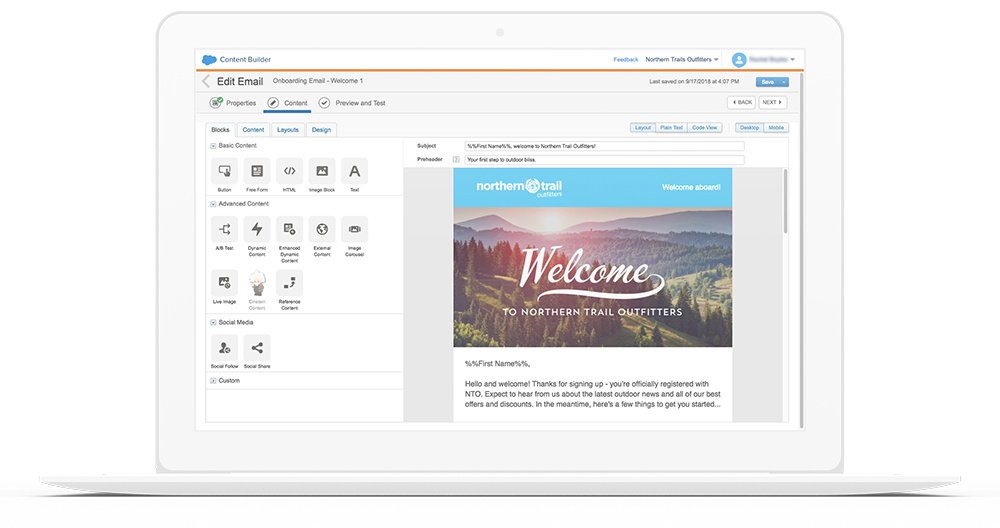
Sales Force eMail Studio is a module in Sales Force cloud with mobile responsive interface that supports in email video delivery.  Your brand can create timely and highly relevant messages to engage and re-engage customers. Drag-and-drop tools make it easy to create emails using simple content blocks.  Sales Force eMail Studio enables you to use advanced segmentation for unique content blocks and multi-variate testing.

Marketing Cloud Email Studio email content builder screen displayed in a laptop device

Constant Contact

Constant Contact is a top performing eMail platform provider that enables easy drag and drop eMail communications builder.  You may segment your lists by finding like qualities in behavior and create targeted sends. However, you must manage your own cadences as there is no smart sending that prevents over-mailing.  However, there are some fun bells and whistles that come with this email platform; you can build landing pages to collect eMail or provide a highly customized experience.

You can also share your emails to your social channels – though this would not be a best practice as now you are speaking to your whole audience when hopefully your email is segmented to speak to one of many audiences in your segmentation.

Sendinblue

This is your low-cost leader with the maximum bells and whistles. Sendinblue has very low subscription fees along with drag and drop email creation. You may use an existing template, build your own, or drop in html.

Sendinblue’s real power comes from the flexible and versatile marketing automation platform. The Sendinblue Tracker script lets you track web behavior from your contacts and use this information, as well as email engagement and data from your contacts, to create complex automation workflows that can save you time and help you scale and grow your business with no work at all.

eMail Platforms for eCommerce Providers

When you are selling online and looking for the ultimate in email opportunity, you really want to check under the hood. You want an eMail platform that hooks right into your eCommerce. At a minimum you want to load products directly from your catalog in your segmented blasts. You also want to be sure to have the following automations available:

Abandoned Cart eMail

Browse Abandon eMail

Welcome eMail

1st Purchase eMail

Back in Stock

Listrak

This advanced eCommerce email platform provides everything you need to intelligently market to your prospects and customers alike.  From easy drag and drop creation which is the least of folks worries these days.  This email platform also includes insights, accelerated growth email collection tools for your website, behavior triggers, and customer unification.

Klaviyo

The whole shebang.  Klaviyo allows all the automations referenced above as well as the opportunity to create your own custom flows. Klaviyo also has advanced insights into your customer data.  You can go to your customer activity and see who has been on your website in the last several hours, frequency of visits, source of acquisition, and email opens and clicks at the user level.  The data is extremely rich here and with an analyst may help you create rich customer segmentation.  Klaviyo has many pre-built templates with drag and drop functionality as well as the ability to connect your eCommerce store directly to Klaviyo to populate SKUs.  Klaviyo also has smart sending to help you keep your list healthy.

While there are many options with different nuisances, the one sure piece of advice is to start emailing; once you start the basic, you can only go up from there.  Start a drip campaign to your prospects and then you may start customer segmenting, automations, and advanced analytics to really sell to your prospects, customers, and uber fans in the best possible way.

Your Omnichannel Marketing Strategy Checklist

Master Omnichannel Marketing with These Tactics

There are so many ways to reach your target audience these days that you need to be sure you have the optimal set of tactics aligned with your message. The entrance of omnichannel marketing tries to assimilate an order to your media strategy while maximizing impact and minimizing costs. Some media tactics are better than others depending on whether you are selling a product or service or selling to another business or consumer. We’ll be sure to call out the differences in the checklist to help you determine what’s best for your brand.

Omnichannel marketing is the practice of reaching your audience through multiple touch points where they typically go – this can be a physical, digital, televised, audio, and more pending your target’s job role and consumer behavior. From outdoor marketing you see at a bus stop or behind a plane at the beach to experiential trade shows and everything in between, we’ve got a comprehensive list of ways to reach your audience.

Omnichannel marketing became popular because of the many ways in which shoppers can now buy; you want to be sure to reach your audience where they are.  Harvard Business Review found that 73% of all shoppers shop across channels.  You don’t want to miss out on that market share!

Another key opportunity when testing media is to identify a geographical location where you will excel by building critical mass with flawless execution. It’s fantastic to hear from clients, “We see you everywhere.”  This can be accomplished by targeting a region where timeliness and support are 100%; this will make all customers in the region satisfied and enable you to focus a smaller budget in a smaller region to reach critical mass to look much bigger than your brand may be. To determine your critical mass geolocation, you will want to consider where your service agents are or where your warehouse is. You want fast service with excellent satisfaction as this will also support word-of-mouth marketing and loyalty, which are just as important as the first sale.

Next, you’ll need to recognize the difference between where and with what. We can reach our audiences in different places which covers targeting.  What we say to them and how we serve it to them is the creative, which is an entirely different discussion. Today we will focus on targeting your audience.  Start by defining your audience.

  1. Is your audience a consumer audience or business audience?
  2. Who is your audience? What is their average age? Is it both men and women?
  3. Is your product category widely known or new? (hint: You may need to create a broader awareness campaign to identify who needs your product / service)
  4. Where do they go to find information on your product / service?
  5. Where does your audience spend time geographically?

Today you have so many ways to target your audience on so many different platforms. From broad (which works for many brands such as insurance and toothpaste) as you are looking for adults that use a product that has very broad demographics to insanely specific targeting to identify patients with a rare illness that your product helps.  We’ll cover all of the targeting methods available and what they are good for.

Keyword Targeting

Keyword targeting enables you to create a list of keywords and upload them into your ad platform. This will target individuals searching on these keywords.

This is good for both broad and specific.

Keyword Retargeting

Keyword retargeting enables you to upload your list of keywords and have your ad served to individuals that have searched on these terms in the past 30 days.

This is good for both broad and specific.

Demographic Targeting

Demographic targeting enables you to select priority demographics such as age, income, home ownership, presence of children, luxury car driver, and much more.

This is good for both broad and specific.

Native Targeting

Native targeting is where your content is published among similar content on other websites. This is to make your content appear organic and appeal to the audience already reading similar content, while in fact, your content is paid.  Your content will be labeled as a sponsorship yet typically gets more engagement since it is native content.

This is excellent for very specific targeting where you want to be among the content these readers are already consuming about your niche.

Geoframing

Geoframing is the ability to target folks that have been in a specific location at an earlier date with digital ads once they have left the location.  An example of this may be the Chicago International Home Show is the world’s largest tradeshow attended by some of the most powerful buyers in the world. While they are far too busy at the show to be engaging with ads, you may serve these ads for the next couple of months to anyone that was at the show during the event timeframe.

This is very specific as you have identified the audience you know you want and now you are employing a unique tactic to reach these folks.

Geofencing

Geofencing is the practice of identifying locations and serving mobile ads to users at the location or within a specified number of miles from that location. An excellent example of this would be the coffee shop chain that advertises between 6-10 am when you are within 1 mile of one of the locations. The coffee shop owner may offer a BOGO coupon to persuade you to try their coffee shop.

This is less specific than geoframing but more specific than generic targeting – as folks that all go to the same location typically have some things in common but maybe not as much as those that go to the same convention.

Conquesting

Conquesting is the practice of stealing customers from your competition. You may simply provide a list of websites that you would like to advertise to their traffic and identify which sites may be available in your ad servers platform.

This is great for almost every product and service you may think of – get their attention and let them know how big the market is and what their options are.

Lookalike Modeling

This would include uploading your client list so that machine learning can identify more folks that look like this so you may grow your reach without wasting impressions on audience members that do not have similarities with who you know buys your products.

This is as targeted as your list is – if you have a list of realtors, this would be much more specific than folks looking to buy a home merely by nature of having the same career.

Retargeting

Retargeting in the general sense is serving ads to customers that have visited your site and not purchased. You will serve ads to these users reminding them of your product or service. Ladies, we’ve all had that shoe ad follow us around for days until we finally agree… we cannot live without these shoes.  This is one of the most successful ad tactics around, delivering more conversions than most.  Important to note that the cost to convert should include up-front advertising as omnichannel marketing must account for all expenses to convert a customer.

This is very specific as you are getting folks that already have shown interest in you to look at you again.

Cross-device

Cross-devise targeting ensures you get your customers not only on mobile but also on their desktop and connected TV where the display and engagement stand to tip the scales much more than the small screen of your phone.

This is another specific target as you are getting a second exposure from folks that saw your ad on their desktop and now will see it on their phone or vice versa.

Email Targeting / CRM

Reaching customers and prospects in email is another one of the tactics your brand cannot stand to miss out on. Adding a drip campaign may be decades old at this point, yet it’s surprising that over 50% of all brands do not employ this tactic.  As simple as uploading your list and staying in regular communication can change your sales landscape drastically.

This is very specific as you already know who you are speaking to and at which stage in the marketing funnel they land.

Event Marketing

Does your product or service speak to a tradeshow like venue? This is typically a B2B product or service and has an entire industry dedicated to supporting the networking and sales opportunities of items you traditionally would not buy online. This includes multi-million dollar software applications, service providers, industry specific technology, mass purchasing opportunities, and a lot more.

This is another vertical that is very much like native advertising but in person at a convention; you are reaching your target buyer in a specific niche – they call this shooting fish in a barrel.

Outdoor Advertising

This world has definitely changed but outdoor advertising is as viable as ever – just ask Times Square. From digital billboards, cars wrapped in brands, bus stops, wrapped store fronts, sporting event venues, mobile billboards, benches, sponsored highways, and more, there is plenty of physical space to ensure your exposures are reinforcing your message in your target market so that your brand recall is high.  High brand recall makes you the brand of choice when purchase time comes around.

This is a very low target – excellent for insurance, toothpaste, banking, got milk, movies, and more.

Direct Marketing

We have learned that history repeats itself and that plenty of tactics can get diminished when the tactic has become saturated. At one point in time we had more “junk mail” or highly targeted direct mail as we like to call it, than real mail and it became a blinder – we stopped reading it. Now that our email box has become overwhelmed, direct mail is coming back around to be a popular method of alerting folks to new products and services.  The Direct Marketing Association found that oversized postcards have the highest response rate of all mediums available – that’s pretty impressive in this day.

Combine this with EDDM (every door direct mail) available by USPS or any print shop, will save you money by sending your postcard via carrier route without postage. Now you have the highest response rate with more affordable delivery rates – something to write home about.

This is a lower target based on the lack of information you have on mail carrier routes.

Print Publications

Another tactic that may seem dated and overpriced, but it’s not is print ads.  Advertising in a relevant magazine with a product or service that resonates with that audience brings validity to certain audiences.  You will also find that these publications typically have digital associations that will make your purchase more efficient by reaching the same audience on different platforms, giving you the multiple exposures you need to convert a customer.

And let’s not forget that the pandemic brought QR codes back to life in a more useful way – drive customers to meaningful and complimentary content from your print ad – offer surprise discount or free gift with purchase when the QR code is scanned.

This is another lower targeting opportunity as your demographics may be generic unless you are in a native publication and then you’re back to shooting fish in a barrel.  An example of this would be selling your camera in a photography enthusiast magazine as opposed to selling it in People magazine.

Partner Opportunities

There are so many complimentary opportunities to products and services that we really need to think inclusively to identify complimentary opportunities; these may be reciprocal or may be self-serving. This only impacts price as you may find a brand where you can swap email ads and include each other in emails or inbox flyers as well as you may find a one-way opportunity to pay to be included in another brand’s marketing or charge to include others in yours.  An example of this would be a meal subscription service where the subscription service includes an inbox flyer for a kitchen equipment supplier with a discount and the kitchen equipment supplier includes a value add coupon to the meal subscription service.  Both brands come out looking great offering complimentary discounts and that’s the only cost associated with this program.

This can be as targeted as your partner is.  If you have a very niche partner, chances are this will be excellent high quality and detailed targeting.

Public Relations

Let’s not forget the power of the pen and the media. All brands should be using press releases and media exposes to share product launches and big news with the industry of relevance. If you launch new products at a tradeshow, it most certainly is newsworthy and should be published over the wire. In addition, you should make industry relationships and send certain publications and influencers the release directly.

This is much more generic and should be hand distributed to journalists in your niche.

In Conclusion

Reaching your customers where they shop has certainly changed over the decades; though with this handy guide you should be set to start your omnichannel marketing plan to hit them where the shop and live just as though it was 1988. Be sure to consider your messaging and storytelling based on the medium you are engaging. Each platform should have a different tone with different goals for each stage of the marketing funnel.

7 Webinar Marketing Tips for Record-breaking Attendance

Webinar marketing via online events is a powerful resource to attract, educate, and convert new clients. Research shows that just one webinar can generate over 1,000 leads!

But with the growing number of online events, how do you convince interested prospects that yours is the one not-to-be-missed? Better yet, how do you create an experience that will leave a memorable, lasting impression on participants?

Here are 7 proven tactics for creating and promoting a webinar event that will result in record-breaking attendance and rousing success.

1. Select a Hot Topic

If you want to attract attendees, you need to start with a sexy topic- broad enough to appeal to a wide audience but targeted enough to offer participants tangible takeaways. For example, your overarching theme could be “Optimizing the Customer’s Digital Experience” with a focus on the process of mapping the customer journey.

Put some serious thought into the title of your webinar as well, using popular keywords that are searchable. Make sure you repeat the same title in all promotional and follow-up content to bolster SEO ranking.

Important note: your topic will only be as good as your content. Remember, your ultimate goal is to deliver value to and strengthen relationships with your customers. Period.

2. Sweeten the Deal

Getting people to register is only half the battle. You need to make sure they actually show up. So why not offer an extra incentive or two?

People love to feel like they are getting exclusive gifts. Giving away tickets, VIP memberships, or retail items is a great way to stir up excitement, offer something of value, and showcase your products and services, all for a very low cost.

Be sure to announce your giveaways in your emails and marketing posts, but maybe hold off announcing the winner until the end of the webinar…to make sure everyone sticks around.

3. Invite Expert Speakers

Featuring one or more influential guests is another way to boost attendance and increase your webinar’s credibility. Industry leaders and accomplished experts can offer unique perspectives and experiences that will make your event more relevant and valuable for your audience.

If you find a personable speaker that is prepared to field questions, include a live Q&A at the end of the session. People who are eager to learn from the best love the chance to interact with experts in real-time.

4. Recruit a Partner Brand

Two brains are better than one. Two-well-aligned brands are more powerful than one, generating more energy, creativity, and enthusiasm for your participants.

Plus, you have the added bonus of a co-marketer who can tap into their varied and hopefully, expansive audience. If you sync up your marketing strategies, you can create a promotional powerhouse that could bolster your attendance exponentially.

5. Select the Optimal Date

This might go without saying, but your participants need to actually be available in order to attend. Although research favors Tuesdays, Wednesdays, and Thursdays between noon and 2 p.m., the optimal time will ultimately depend on the lifestyle and preferences of your specific audience.

An effective tactic to gauge what works best for your participants is to send out a poll. This helps you nail down a time and will also give you a feel for how much interest there is in your selected topic.

6. Promote, Promote, Promote!

As soon as you get your topic, key speakers, and dates sorted, you need to start promoting like your event depended on it…because it does. Create a dedicated webinar hashtag, and wherever your audience is, find ways to promote your webinar, prioritizing the following:

Implement an email campaign

Forty-five percent of marketers choose email as the most effective promotion tool because it works. The best approach is to set up an automated campaign so you don’t have to think about it again.

Three reminder emails is a good place to start- one email the week before the event, one the day before, and a final reminder between 7 and 9 a.m. on the morning of. An initial thank-you email is also a good idea to confirm attendees’ registration and prompt them to add the webinar to their calendar.

Be sure to include a CTA and the webinar’s hashtag to encourage recipients to share registration info with friends and colleagues.

Coordinate your social media channels

Use your social media channels to pepper in updates and rev up anticipation for the webinar, increasing in number as the date approaches.

You will attract more attention (and attendees) if you incorporate visual content such as graphics, photos, or teaser videos into the marketing mix. And you will attract more marketing ops if you send your presenters and partnering brands event details and promotional info in an easy “copy/paste” form (and tag them in every event post).

Write a blog post

You can rev up interest and attendance via your blog, highlighting the topic using the same title as your webinar. Include links to your featured speakers and other related prominent sites to boost SEO.

And don’t forget to include the webinar CTA and registration details!

Leverage your homepage

Your homepage is prime real estate for promoting your webinar. Put the details front and center, including:

  • What- Theme & related topics
  • Why- Benefit of attending
  • Who- Presenters
  • When- Date and time
  • Where- Link to registration and/or event

7. Encourage Feedback

Opinion surveys can serve as a gateway to build and strengthen relationships with attendees. Ask participants to share their thoughts and offer a thank you gift in return (for better response rates).

Their feedback will give you a chance to follow up with offers and announcements and help ensure your next webinar is bigger and better.

***

Webinar marketing is one of the most effective ways to strengthen customer relationships, generate new leads, and establish your brand as a leading expert in your field. So don’t let the fear of a low turnout to your event stop you.

If you build it, using the tactics above, they will come.


ALERT: Direct Mail is Not Dead

With all the hype around digital marketing, many brands have forgotten the power of direct mail. Now, with people spending more time at home, direct mail marketing is not only still relevant, but it could be the best way to reach existing customers and drive new business.

In contrast to the dread people feel dealing with the 121 emails that hit their inbox a day, 4 out of 10 people actually enjoy checking their mailbox.

And studies show that open rates for direct mail are close to 90%, which is significantly higher than click-through rates for most digital marketing efforts.

Here are five direct mail marketing tips to optimize your marketing strategy and jumpstart your sales.

#1. Locate Your Audience

Before you dive into design and content, you need to make sure your mailer ends up in your customers’ hands and not their trash.

Even the best offer will flop if it’s sent to the wrong audience, so you need to think carefully about which of your buyer personas match your current promo.

Next, you need to find them. There are various compiled lists and response lists you can purchase, but your best option is your own internal database list.

First of all, it’s free. Second, you already have a connection with those in your database from previous transactions or interactions. Plus, you have detailed data about the attributes and purchase behavior of previous customers to help personalize and segment your mailings.

#2. Get Personal

Personalizing your direct mailers can dramatically increase the performance of your campaign. According to the Small Business Trends survey, just putting a name on your direct mail can increase open rates by up to 135%.

There are many options for personalizing mailers depending on your budget and capacity. Simply addressing the mailer to the recipient’s name will pique curiosity, while handwritten envelopes boast an open rate of close to 100%.

One effective approach is targeting previous customers with a thank you or birthday coupon for their next purchase. Add a sense of urgency with a limited-time off, and chances are good, your ROI will increase too!

#3. Build Your Unique Brand Image

Direct mail is an excellent way to build your brand image and keep your products and services in your customers’ minds.

The average consumer keeps mail around for up to 17 days , longer for the content they select for fridge decor. This means your logo and branding will most likely be seen repeatedly.

Make sure the look and feel of your print mail are consistent with your other marketing efforts to promote brand recognition. And don’t forget to add your website and contact information!

#4. Visual & Content Tips

You have less than 8 seconds to capture your customer’s attention, so get creative with your visuals.

Think of images that reflect your brand’s personality but will also make your customers want to take a closer look. (no stock photos!) But balance your images with your content so you don’t drive attention away from the main message of your print ad.

And don’t forget your CTA that creates a sense of urgency or intrigue to seal the deal.

#5. Measure the performance of your mailers

Once you map out your plan, get your tracking mechanisms in place to measure the performance of your mailers and tweak as needed for your next campaign.

You can also take advantage of A/B split testing to optimize your strategy by sending out different mail versions and monitoring which performs better. Testing your headline or CTA is great places to start.

But you don’t even need sophisticated analytics tools with direct mail. You can quickly check the response rates by simply counting the number of redeemed coupons, phone inquiries, or page visits. Yes, it’s an extra step, but you’ll be surprised the difference one or two words can make in terms of revenue gain!  Do not forget to set up your custom landing pages and phone tracking so you can track all sales.


***

No, direct mail is not dead, to the contrary. Studies revealed that direct mail recipients purchased and spent 28% more than those who didn’t receive a mailer. And with so many customers working from home, now is the best time to use these simple tips to get in front of your prospects with targeted, alluring marketing to get a boost in revenue and customer acquisition…the old-fashioned way.


Over the Top Media: Laser Focus Your Advertising

“Whether viewed on a connected TV set at home, on a streaming device at the gym, or on a desktop at work, video content remains an advertiser’s most powerful tool to connect with audiences, wherever, whenever, and however they may be watching.”      – IAB – Interactive Advertising Bureau

Since over the top media  is quickly becoming the new norm, it’s crucial that brands understand how to maximize the advanced audience targeting capabilities that come with digital advertising.

Because without the right target market solution, your ads will not reach the right consumers, which is definitely the wrong approach.

Here is a deeper look into how over the top media targeted advertising can reduce your ad spend and maximize your growth in the year to come.

Streaming Ads are the hottest new way to reach your audiencece.

OTT Targeted Marketing Options

The biggest advantage of OTT for marketers and consumers is the personalization of the experience. The more tailored your brand’s ads are to your audiences’ needs and interests, the more receptive your audience will be to your ads.

Below are a list of the various targeting methods that harness the power of OTT ads through precise, granular targeting.

Demographic targeting uses a combination of variables to identify the right audience for your products based on characteristics such as family size, income, and educational level, etc.

Demographic targeting

Brands can also employ geotargeting, leveraging GPS data to target customers at the household-level. For example, a politician might want to present different campaign issues to voters living in urban areas vs those who live in rural communities. Advertisers can geofence certain lateral and longitude zones to hit the neighborhoods on interest.  Keep in mind when advertising using this method that you will be hitting all devices in that home including kids and teenagers.

Technographic targeting uses device characteristics to find potential customers- desktop vs mobile; iOS vs. Android; and Chrome vs. Safari. Here’s how it works in action:  After discovering individuals using Mac computers spend 30% more a night on hotels, Orbitz.com was able to increase profit margins by targeting Mac users with higher-end hotel ads.

Contextual targeting, in contrast, reaches audiences based on keywords and website or program content. So a company like Le Creuset might run its ads on a popular cooking show while a sports sunglasses retailer might choose to advertise on runnersworld.com.

Day Parting references the ability to flight your ads during the hours of the day you want them viewed. This controls when your ad will be viewed to reach your preferred customers at the perfect time. If you were aiming to get your products in front of sports fans, for instance, you could choose to run them during a televised game.  And we’re all familiar with the popular pizza commercials that start floating across our screen at 6:00 pm; these would not be effective at 8 am as pizza joints are not open then. However they may very well be successful with the hold pizza has on Americans.

Behavioral targeting tracks consumer browsing and purchase history, allowing you to target consumers who are already actively shopping for the products or services you sell.

To take it a step further, connected TV ads enable brands to display highly personalized content across a single user’s multiple devices. Research shows that two out of three people use a second screen to search for a product they saw advertised during a program, so you can retarget viewers at the moment they are primed for purchase.

Consider the following scenario: A man uses his desktop to search for new drill sets on Target’s website. He gets tired of browsing and starts watching a Netflix show on his TV, which uses the same IP address as his computer. Within minutes, he starts seeing ads for drill sets on his screen, inspiring him to look up a product that caught his attention.

How to get started with OTT Marketing?

Identify Your Audience & Call to Action

As with all marketing endeavors, you need to know who you are targeting to create content that will resonate with and reach your audience. Still not convinced? Reporting shows that data-driven ads typically bring  between 5 and 8 times greater return on investment.

It’s equally as important to identify what your ad’s CTA is and make it as possible for viewers to follow through. Interactive CTAs are the most effective, making it effortless for the viewer to click directly on the ad to take action.

However, not all connected devices are “clickable,” which is another reason you need to research your audience. Once you know what devices and platforms your ideal customers are using, you can integrate the best sizing and format practices to optimize your results.

A popular offline method for tracking response is offering something exclusive in text so that your audience is incented to text you while the ad is streaming.

Create Content that Goes the Distance

OTT advertising still requires a level of quality and standard best practices that any media campaign would. Some third-party ad networks like Google Ads will provide you code, which allows you to run ads automatically with little development work. But in most cases, you will likely need to create custom content to meet platform-specific requirements.

If you haven’t done video advertising before, it’s worth investing in a professional video agency to help you create high-quality content. Even if you start small, it’s better to have media that will make a great first impression and work across multiple devices and platforms.  If you’re looking for a quality video partner, you may consider our sister company Classitech.

OTT Programmatic Advertising & Real-time Bidding

Programmatic Advertising is the best way to get your ads shown on premium programming, but Real-time Bidding (RTB) will get there for a lot less.

RTB means that ads are bought and sold on a per-case basis, based on availability and the specified characteristics of a brand’s target audience. Each time someone visits a website, his or her data is sent to an ad-exchange that initiates a real-time auction between interested advertisers who match the criteria.

We’ll use our friend shopping for drill sets as an example. Each time he visited a site, ad-exchange agencies used OTT targeting to collect data that matched the requirements of interested bidding advertisers. So the ad he saw while watching Netflix was that of the winning bidder.

***

There’s no question, OTT advertising is quickly becoming the primary way to reach your target audience with premium content. Now that you know the lay of the land, it’s time to stake your claim on the ever-expanding opportunities to laser-focus your digital marketing strategy for unparalleled success!

How to Write a Press Release & Get it Picked Up

Press releases are great tools for getting local media attention.  Pending your product or service, you may even want to target national media outlets.  Because your target audience is a media outlet, this means that you need to appeal to them in a way to get your content noticed and picked up.  Your information must be newsworthy and reported as news, and not as marketing and advertising messaging.

There are basic features and elements in press releases; and even more are being made available as news evolves in the social media genre we’re living in in 2020.  It’s becoming more acceptable to include video, social links, and images, whereas in decades prior, it was custom to only provide text releases.  There were fewer distribution channels which also made this an expensive option.

Today there are many methods to getting your press release noticed – let’s start with the sections of the release and how to write for the media.

Your release is a basic recipe like most repeatable content pieces. This makes it easier for reporters to find what they’re looking for and expedite the writing process.  Your release should start with the current date, city and state of news location.  The introduction paragraph should announce your news and who your company is in a nutshell.  Be sure to reference your company website after your company name with the https:// and you will get backlinks when your release is published and shared online.  The backlinks help your website rank in Google and Yahoo.

Your 2nd and 3rd paragraphs should go into further detail of the news item.  If it’s an event, be sure to cover who will be there, what the event is, why the event is being held, where the event is being held, when the event will occur with date and time details as well as when the event is scheduled to end.  If this is a product or service, be sure to cover who the product or service is intended for, why it is good for this audience, what it will do for the audience, where the product or service is useful, when the product or service is useful as well as its features and benefits.  You should also include a quote in both your 2nd and 3rd paragraph; one from the founder and one from a customer.  Lastly, you should place your video between paragraphs 3 and 4, sandwiched between the news rich space.

Your 4th paragraph is the wrap up paragraph where you recap your announcement and close the release out.  This paragraph is also where you will announce any future product or service news. (e.g. Contest Factory plans on releasing 20 more new products this year to further support their gamification brand.)

Your last content block will be the About paragraph at the bottom of the news release.  This is where you can go into more detail about your company and what your organization does.  You would reference the organizations’ inception year, industry, and unique assets for your brand here.  This is also where you would place your social media links.  Be sure to include Linkedin and have your profile decked out as news releases typically resonate well on this platform.  Your final note in this section is the press contact with first name, last name, phone number, and email address.

Now that you have your release prepared for local and national journalists, it’s time to distribute this.  There are a few options here.  You can hire a PR firm or use your own forces to get media.

PR Firms will offer a varied level of services and you pay them for their relationships and skills to traffic your news release and get media attention.  This is costly and does not have guarantees.  Typically, PR Firms operate on a retainer and are not, “one off” news releases.

There are plenty of ways to get your own media attention. You can publish your release on PRNewswire, PRWeb, SBWire, or a host of other online newswire services.  These services distribute your release to different levels of media audiences, based on what you pay. You can pay add on services to target different markets and include your video.  These services typically drive backlinks because plenty of news sources publish releases as is to have fresh information for their readers online with no cost of writing and editing.

You should also note all the journals, magazines, websites, brands, and locations you want your release noticed.  Identify your audience and target what they would read.  If you are publishing a beauty product, you will look up Cosmo magazine and find the beauty column editor.  Create a list of all news journalists you are targeting from newspaper to LinkedIn, and Facebook alike.  Next you need to find them online to get their email address and twitter handle; these are the 2 best ways to get noticed as they are direct messages. Journalists information is typically published in their column, and on the publication website.  Send each email or tweet individual with a note as to why you wanted to get this release in front of the journalist and appreciate their column.  This same approach works with instant messaging your release on Facebook and LinkedIn.

These methods with reliable use will start to get you noticed and published.  Be sure to follow the tips from content to distribution and you’re sure to get backlinks, shares, and attention to your news.

Direct Marketing: Content is Still the King

Direct Marketing is ALIVE and WELL

Direct marketing has been around for as long as the marketing business itself, and despite what you may have heard, it’s every bit as powerful as it ever was. According to one recent study, the average direct marketing household response rate is about 5.1%. Paid search comes in at just 0.6%, for example, and online display only manages 0.2%.

But having said that, it’s also important to note that the very concept of direct marketing has evolved over time — and it’s continuing to do so, even as we speak. Time has long since evolved this science into a series of hardened digital methodologies, yes — but the principles all roughly remain the same. Therefore, if you really want to harness the full power of direct marketing to your advantage, there are a few key things you’ll want to keep in mind.

The Art of Acquiring Data

If you want to reach out to a prospect with the right message at exactly the right time, you obviously need to know “where” that message is going. But to put it in no uncertain terms, the age-old technique of list buying is more or less officially dead.

Now, you need to invite your customer to give you this information in the most organic and transparent way possible. Running a sweepstakes or user-generated content contest on your website or social channels is a great way to do this, since many people will gladly sign-up and exchange personal information for the chance to win a prize.

Likewise, you could run some other type of promotion. The key ingredients here involve A) an incredible offer that people are naturally drawn towards, and B) an in-your-face graphic design that captures people’s attention in a way they won’t be able to look away from. If you’re able to accomplish those two things, you’ll have no limit to the amount of prospect data you can draw from.

Content is King

Equally important to direct marketing is content — something that again exchanges value (in this case, information) for a deeper relationship with your brand.

Long-form content that is valuable, relevant, and genuinely helpful is a perfect way to sell your reader with facts, claims, and testimonials at your disposal. This type of content won’t just establish you as an authority in your industry; it will also develop a sense of trust between you and your audience, making it far more likely that they’re willing to take that relationship to the next level.

Emails and Retargeting

A large part of direct marketing comes down to email, and because of this you must remember one very hard and fast rule: your subject line dictates clicks and conversion rates. If you have an email with a compelling subject line, not only will your open rate improve, your CTR (click through rate) will do the same.

These days, your direct marketing campaign will usually involve first acquiring a series of emails, and then sending out targeted email blasts. Always remember: it’s important that you work to create multiple impressions of the same message, but still intend to sell on the first.

Also, don’t forget that your efforts need not end with that blast. Those same emails can later be retargeted on social media sites like Facebook, Twitter, and more. Using the same valuable, timely, and relevant content on multiple mediums is almost always a way to generate multiple impressions.

In the end, if you keep all these things in mind, you won’t have to work hard to get the buy at all. In fact, you won’t be asking for the purchase — the purchase is going to come right to you.